For the want of a nail, the shoe was lost.
For the want of a dishwasher, the book was delayed.
It's still under warranty (hurrah!), but the repairperson from Sears won't arrive until August 19th. Think of me, dining on Chinet and eating pizza until then. Sigh.
Wednesday, August 10, 2005


Tuesday, August 09, 2005
Litblogs & Doris Lessing
Scott (of Conversational Reading) has a nice piece on litblogs over at Rain Taxi (via Genevieve, weeks ago now [and Scott, why no women bloggers on your short list?]) and Bud links to a nice piece from the Wazee Journal (don’t know what that is) about the phenomenon of litblogging from a fellow addict:
I seldom check my own statistics, but I can tell you that they’ve been stubbornly stable for months (with a giddy-making small uptick last week—welcome to all three of you!), besides, this is a hobby, a pastime. When I was struggling through The Golden Notebook however, I did do a technorati search on Lessing, which led me to Thomas Schminke’s very interesting Withered Fields, a blog that combines philosophy with literature in ways very different from the usual fare on the blogroll. Check it out.
Most amazing of all, though, was the sheer coincidence of it: that, that very week, I could prove that there were two of us reading Lessing’s masterpiece and even copying some of the same passages into our computers. It made for good company during some tough reading and has made, I think, for some good conversation in the comments here. I'm grateful to blogging and to Thomas. If that isn’t a great compensation for slogging through the Lessing, I don’t know what is.
Having his virtual company is almost enough to make me consider blogging more about Lessing. We’ll see how the week goes. (I’m back in the city and a bit dazzled by the gorgeous shoes I saw on the uptown B this morning--on the feet of a woman reading my college's alumnae magazine.)
But I offer this warning: lit blogs can be addictive. I have found myself awake in my den at 3 a.m., checking my Bloglines blogroll of blogs, hoping for new posts by Rake, GalleyCat, Grumpy Old Bookman, or Bookslut. And experimenting with lit blogs may lead to harder drugs, i.e. the political blogs…
I seldom check my own statistics, but I can tell you that they’ve been stubbornly stable for months (with a giddy-making small uptick last week—welcome to all three of you!), besides, this is a hobby, a pastime. When I was struggling through The Golden Notebook however, I did do a technorati search on Lessing, which led me to Thomas Schminke’s very interesting Withered Fields, a blog that combines philosophy with literature in ways very different from the usual fare on the blogroll. Check it out.
Most amazing of all, though, was the sheer coincidence of it: that, that very week, I could prove that there were two of us reading Lessing’s masterpiece and even copying some of the same passages into our computers. It made for good company during some tough reading and has made, I think, for some good conversation in the comments here. I'm grateful to blogging and to Thomas. If that isn’t a great compensation for slogging through the Lessing, I don’t know what is.
Having his virtual company is almost enough to make me consider blogging more about Lessing. We’ll see how the week goes. (I’m back in the city and a bit dazzled by the gorgeous shoes I saw on the uptown B this morning--on the feet of a woman reading my college's alumnae magazine.)
Thursday, August 04, 2005
Hello, Dolly!
The mind is a funny thing. After five weeks upstate, we’re heading to The River (St. Lawrence) for a long weekend and then, on Monday, back down to the city. So, this morning, I sat down at my little carrel in the Hamilton College library and something told me I just needed to get a new song on i-tunes. Why the finale, the title track of “Hello, Dolly!”? It took a listen for me to get the message?
Do you think I’m glad to be going back? Hmm…
“Hello, Dolly!
Well Hello, Dolly,
It’s so nice to have you back where you belong…
“Here’s my hat, fellas,
I’m stayin’ where I’m at, fellas
Dolly will never go away again!”
Do you think I’m glad to be going back? Hmm…
Wednesday, August 03, 2005
Place names as metaphors
One of this summer’s projects has been to edit a collection of essays by college freshmen (a little in-school journal), so I must credit my student, Ashley Ritchey, for sparking this observation. Her paper on Jhumpa Lahiri’s “Sexy” (from Interpreter of Maladies got me going on this track for she notices something really cool: the male lover in the story, turning his mistress into a sex object rather than treating her as a person, takes her to places in Boston that underline the way he looks down on her: The Mapparium, the Nickolodeon.
I lived around Boston for eight years, so those are just names to me: familiar and delicious because I can picture just where they are. But Ashley didn’t know they were real places—to her they were metaphors for the way Dev treats his mistress.
A couple weeks ago, we drove through Herkimer and I saw the Empire Diner, an old, run down but still beautiful stainless steel and neon creation. My husband reminded me that Richard Russo is from these parts, that surely Empire Falls has that very diner as its imaginative origin.
When you don’t know a place and read about it in a novel, the place names become metaphors, lovely little symbols of the text itself. There is always a strange shock to learn that those very names are simply lifted from the spot—not metaphors created by the writer, but little moments of realism in the book. The invention, the imagination, has come first from the small businessperson who named the diner, the movie theater, the café, and then from the writer who chooses one diner over another to best capture the mood of her work.
So, I made a list of places in Seattle that were important to me when I was in high school to see if, from that list alone, I could find a mood or a tone:
I can see, just from the list, a kind of West Coast hippie imitation in the movie theater names: not muses, like in New York in the old days, but still mythic-sounding. Also, it’s pretty clear, I think, that Dick’s is the burger joint we hung out at—a different mood from other things here. And two places with “Exit” in their name: a tribute, I think, to enthusiasm for highways and a sense that Seattle was the edge of the country. It all sounds very seventies to me, though I was in high school in the early eighties, and like a big hippie hangover—bohemian and a little dirty, homespun.
UPDATE: My father sends along this link: "American Names" by Stephen Vincent Benet. Pretty great. Thanks, Dad!
Elsewhere, over at House of Mirth you can read an interesting interview (and below, a review) with Richard Stern, whose books have been reissued by Northwestern UP.
I lived around Boston for eight years, so those are just names to me: familiar and delicious because I can picture just where they are. But Ashley didn’t know they were real places—to her they were metaphors for the way Dev treats his mistress.
A couple weeks ago, we drove through Herkimer and I saw the Empire Diner, an old, run down but still beautiful stainless steel and neon creation. My husband reminded me that Richard Russo is from these parts, that surely Empire Falls has that very diner as its imaginative origin.
When you don’t know a place and read about it in a novel, the place names become metaphors, lovely little symbols of the text itself. There is always a strange shock to learn that those very names are simply lifted from the spot—not metaphors created by the writer, but little moments of realism in the book. The invention, the imagination, has come first from the small businessperson who named the diner, the movie theater, the café, and then from the writer who chooses one diner over another to best capture the mood of her work.
So, I made a list of places in Seattle that were important to me when I was in high school to see if, from that list alone, I could find a mood or a tone:
- The Harvard Exit,
- B&O Espresso,
- Dick’s,
- the Neptune,
- the Guild 45th,
- the Egyptian,
- Ezell’s Fried Chicken,
- Café Counter Intelligence,
- Baby & Co.,
- the Star Store,
- the Deluxe,
- Volunteer Park,
- Capitol Hill,
- the U-Dub,
- the Last Exit,
- the Pink Door.
I can see, just from the list, a kind of West Coast hippie imitation in the movie theater names: not muses, like in New York in the old days, but still mythic-sounding. Also, it’s pretty clear, I think, that Dick’s is the burger joint we hung out at—a different mood from other things here. And two places with “Exit” in their name: a tribute, I think, to enthusiasm for highways and a sense that Seattle was the edge of the country. It all sounds very seventies to me, though I was in high school in the early eighties, and like a big hippie hangover—bohemian and a little dirty, homespun.
UPDATE: My father sends along this link: "American Names" by Stephen Vincent Benet. Pretty great. Thanks, Dad!
Elsewhere, over at House of Mirth you can read an interesting interview (and below, a review) with Richard Stern, whose books have been reissued by Northwestern UP.
Tuesday, August 02, 2005
Links: Summer reading, light and smart
Moorish Girl points us to some interesting articles and book recommendations for thinking more about the psychology of the London bombers, something I’ve been thinking about a lot myself. It puts Brick Lane higher on the tbr pile.
The TLS review of the new Harry Potter book is worth checking out for its charming and intelligent defense of the book and exploration of their dark turn. The new Harry is my present to myself come 9/1.
Having devoured a second Eloisa James novel as a palate cleanser to The Golden Notebook, I enjoyed reading Saralynn’s defense of fantasy fiction. Genre fiction is surprisingly terrific and addictive--I'm sure that's what keeps Jenny Davidson so energetic over at Light Reading.
So, while my reading turns light, Bud’s back from vacation having read a favorite: Howards End. He’s got a lovely reflection on that great book.
Dave's daughter is reading Mark Twain, but don't go to WordMunger for that: go for the vertigo-inducing pics of canyon hiking and his interesting commentary about their time out west.
29 days to go
Over at Moorish Girl, Laila Lalami is planning to begin blogging on Fridays with news about her new book, Hope and Other Dangerous Pursuits. Her photo, months ago, of the completed manuscript sitting in her printer has stuck in my mind as I count the days before delivering my own. I yearn for that moment of printing all 200 or so pages out and looking at the thick stack. I’ve been working on this book for years now, and, as the end is near, it’s strangely easy to imagine being free of it. At the same time, I’m shocked at how much more I could do, how easy it is to imagine this project stringing out for another summer or two.
But it won’t. September 1 here I come.
Wednesday, July 27, 2005
Nice Curtains, or Bomb the Suburbs
In The Golden Notebook a middle-class, leftist woman character looks at a particularly grim stretch of relentless working class London houses: “’I hate what they put up with. It ought to be swept away—all of it.’ And she made a wide sweeping movement with her hand, brushing away the great dark weight of London, and the thousand ugly towns, and the myriad small cramped lives of England” (188). Her more practical, working class lover points out that the cheap, adequate housing is a material improvement and depressing housing is here to stay.
Lessing’s violent fantasy repeats one of D. H. Lawrence’s from forty years earlier:
Dangerous words for violent times—be it 1920, 1962, or 2005. These suburbs that so offended Lessing and Lawrence are now the breeding ground of new kinds of terror, violence, and discontent, as Zadie Smith, Hanif Kureishi, et al., have been reminding us anew. I think about how right they were to feel that little good could come from these cramped, ugly buildings.
I remember reading in a biography of Lawrence that you could tell his family’s difference from the other working-class folk on his London street because his mother, lower-middle class, would rather do without curtains than get the cheap ones her neighbors did with. She saved for better ones and, more importantly, a piano. Walking down a street of rowhouses in outer London or Jersey City (I realize that I live in an American Islington now), you can still see the same thing: everyone’s bought their curtains from the cheap shop down the road. Then, as Lessing notes, something changes:
Herein lie my own dreams of gentrification. As we think about maybe buying a house, we look at these ugly spots for something that peacock curtains could make beautiful. Could we be, like the painter, the first in a wave? Or will we be stuck on the wrong side of the line in a row of houses that ought to be bombed? Lately, as the real estate bubble looks more like a fact, we resign ourselves to renting on a prettier street. Beauty matters to me—a lot—and I know it affects the psyche. I think about Ursula and Gudrun’s pretty tights and scarves in Women in Love about these lovely peacock blue curtains in The Golden Notebook and, for me, they contain the answer that Lessing and Lawrence don’t seem to quite see for themselves in their grim visions. (Doesn’t Winston’s girlfriend wear a little scarf around the waist of her overalls in Nineteen Eighty-Four?) Ah, color. I don’t want summer to end.
Lessing’s violent fantasy repeats one of D. H. Lawrence’s from forty years earlier:
Once we really consider this modern process of life …, we could throw the pen away, and spit, and say three cheers for the inventors of poison-gas. Is there not an American who is supposed to have invented a breath of heaven whereby, drop one pop-cornful in Hampstead, one in Brixton, one in East Ham, and one in Islington, and London is a Pompeii in five minutes! Or was the American only bragging? (Fantasia of the Unconscious 144)
Dangerous words for violent times—be it 1920, 1962, or 2005. These suburbs that so offended Lessing and Lawrence are now the breeding ground of new kinds of terror, violence, and discontent, as Zadie Smith, Hanif Kureishi, et al., have been reminding us anew. I think about how right they were to feel that little good could come from these cramped, ugly buildings.
I remember reading in a biography of Lawrence that you could tell his family’s difference from the other working-class folk on his London street because his mother, lower-middle class, would rather do without curtains than get the cheap ones her neighbors did with. She saved for better ones and, more importantly, a piano. Walking down a street of rowhouses in outer London or Jersey City (I realize that I live in an American Islington now), you can still see the same thing: everyone’s bought their curtains from the cheap shop down the road. Then, as Lessing notes, something changes:
At this end, the street was working-class, one could tell by the curtains, of lace and flowered stuffs. … But now things suddenly changed, because the curtains at the windows changed—here was a sheen of peacock blue. It was a painter’s house. He had moved into the cheap house and made it beautiful. And other professional people had moved in after him. Here were a small knot of people different from the others in the area. They could not communicate with the people further down the street, who could not, and probably would not, enter these houses at all. (176)
Herein lie my own dreams of gentrification. As we think about maybe buying a house, we look at these ugly spots for something that peacock curtains could make beautiful. Could we be, like the painter, the first in a wave? Or will we be stuck on the wrong side of the line in a row of houses that ought to be bombed? Lately, as the real estate bubble looks more like a fact, we resign ourselves to renting on a prettier street. Beauty matters to me—a lot—and I know it affects the psyche. I think about Ursula and Gudrun’s pretty tights and scarves in Women in Love about these lovely peacock blue curtains in The Golden Notebook and, for me, they contain the answer that Lessing and Lawrence don’t seem to quite see for themselves in their grim visions. (Doesn’t Winston’s girlfriend wear a little scarf around the waist of her overalls in Nineteen Eighty-Four?) Ah, color. I don’t want summer to end.
Kanye West
What could be better than “Diamonds (from Sierra Leone)”? A big sample from an old James Bond theme, Africa, great old school rap, and no misogyny: pretty much all my favorite sing-able themes (good songs about Virginia Woolf and cheese are far to seek). I am smitten. The cause—educating people to buy conflict-free diamonds—seems a bit beside the point to me, but I own no diamonds and am not in the market. Happily bling-free, I’m surely not the intended market for the message. And, of course, the mistreatment of miners is a topic with a long, sorry history. Given that I first saw and heard the song on BET after the video for “Grind with me” (Lyrics: “C’mon and grind with me baby” x 20 with a video to match), I must say that West raised the tone considerably. It’s in heavy rotation here on the laptop and Wow! I’m late to the party on Kanye West, I know. But I’m staying.
Tuesday, July 26, 2005
My Grandmother’s Milton
My paternal grandmother was a great reader but no book collector. As she divided her time between coastal Maine and Florida, her books grew more and more damp. When glaucoma made reading too difficult, she sent her library to me. Boxes and boxes arrived in my tiny studio apartment and I had to decide which to keep. Many were old paperbacks of little value with yellowing pages and cracked spines. Some—like her complete collection of all of Virginia Woolf’s work—I have kept even when that has meant double or triple copies of Mrs. Dalloway. I gave away and tossed many, many damaged books but I only regret one: her copy of Milton. It was full of curious, mean little annotations. Most of them were the intelligent queries of an elderly English major: glosses on words, allusions, or footnotes, questions to ask her reading group. But when I came upon a note reading: “Why doesn’t Graham [my father, her son] see that Anne learns Latin?” and then something further about it soon being too late, the pain was so sharp that I needed the book to be gone. From other evidence in the book, I could, I thought, date that bit of marginalia to around 1976. I was ten. I could not live in the same apartment with the memory of my Yankee Nana who always made me feel like my intellectual life was already spoiled by television and lack of discipline.
Rereading Walter Benjamin’s “Unpacking My Library” today, I remembered that volume of Milton with a pang of regret. I think I could live with it now, but it’s gone.
Monday, July 25, 2005
Summer Cooking, 2: the Radish
I don’t mean to sound ungrateful. It’s more that I’m puzzled.
My mother-in-law planted a vegetable garden down here, as she always does, hoping that we’d reap the harvest. Tomatoes, beans, and carrots are coming on. We’ve reveled in herbs, lettuce, and scallions. But what about the radish? They came on just great. But what’s the point? They are prickly to pick, their greens are unwieldly, they are often bitter. I carry a huge bunch of greens to the kitchen, dirt dripping down, a grimy popsicle-stained (but nonetheless beloved) toddler at my heels. The tops are too woody to snap off so I have to use a knife. They are too crusted with dirt, so I have to scrub with steel wool or that curly plastic stuff. Then, I cut off the tops and tails. Then, my husband announces he doesn’t really like them anyway, so I stick them in a Ziploc bag to await the day when they’ll spoil on the floor of the vegetable drawer.
Who discovered these tubers? Who decided them worth the effort?
They are quite pretty when washed, it’s true. But this summer, I can’t even be bothered to make my nummy radish, dill & cream cheese sandwich.
More on Notebooks
So, as I said, I’m rereading The Golden Notebook (will finish during the beloved toddler’s nap today). It’s still bugging me but also interesting me deeply: the post-it flags proliferate as I read along. It is not a dull book, nor is it a happy one. There’s no joy in the character’s lives but, more painfully, there doesn’t seem to be much joy in the writing of it.
What is deeply interesting, however, is the conceit of the notebooks themselves: black for Africa, red for politics (the narrator is a communist), blue for her diary, and yellow for fiction. I love the image of a writer pouring over a trestle table of notebooks and the fantasy of such organization, compartmentalization is one I share—and sometimes indulge. Now, over at this stubborn world, Jacqui Lofthouse is sharing her own notebook system.
Meanwhile, I read avidly on other blogs whenever someone links to a story about either a writer’s system of writing (I only use a fountain pen at 3 AM; I compose on the computer while listening to Kanye West, etc.) or a writer’s complete exasperation at the questions about the techne of writing. I feel sympathetic to both views. In Q & A sessions after readings, I, too, have been irritated by the weedy questioner, eager to confirm his or her own insanity by linking it to the writer's. Still, one of the great pleasures of writing is physical: having a nice desk or a lovely pen. And, as I find Anna Wulf’s notebooks annoying, I take notes on them on my computer but I do my free-writes in a spiral-bound graphpaper notebook from London. The thick notebook has colored margins, six of them, so I can place my thoughts according to which chapter of the book they pertain to. There’s something deeply satisfying about categorizing free-writes this way—even when they devolve into little meditations on my own inadequacy--they are filed in the “Chapter One: Woolf & the Greeks” section.
For more Lessing, you might check out this review of General Dann: the Lessing listserv is abuzz with it—calling it a horrible review, etc. I thought the book sounded kind of all right: interesting. The ice-covered continent of Yerropp is a little silly: Orwell meets, oh, I don’t know, those great White Mountain? sci-fi books of sixth grade.
Wednesday, July 20, 2005
The Golden Notebook
I’m re-reading Lessing’s masterpiece for my epilogue. In general, these purposeful readings are not much fun: I know what I hope to find in the text and I am trying to read quickly, looking for it, reminding myself that I’ve already had the pleasure, a few years ago, of reading for the plot.
So, trying to make ground yesterday, I read through a good chunk and, of course, got absorbed, nearly forgetting the point of my reading and finding myself sticking dozens of little post-it flags next to passages, words, and sentences I like but are of no use for my current purpose. While this may make me a loyal, true, and good reader, it does make me a poky critic.
The book is great and moving. The structure—a novella about a pair of women friends, one of whom is a blocked writer who keeps notebooks instead of working hard on her second novel—is fascinating. The black notebook, about her youth in Africa, reads like a draft of a novel: characters are tagged instead of drawn, she interrupts herself, the story gallops forward, “the cook” suddenly becomes Jackson at the moment when he is important, without explanation or Lessing’s troubling to double back and give us that name. It feels a little like cheating but it’s fascinating.
It’s also deadly depressing. It and the pressures of trying to finish my own book have plunged me into pretty dark waters. I keep remembering that movie, Antonia and Jane in which the plain woman’s lover couldn’t get aroused unless she read Lessing or Murdoch aloud. She finally rebelled and dumped him. Weeks later, he stands on her doorstep, rainsoaked, clutching a copy of Anita Brookner!
Tuesday, July 19, 2005
Summer Cooking
Academic life means not a lot of money but decent time in the summer. For me, it’s meant years of cadging invitations to housesit and thus, summers of cooking in someone else’s kitchen.
Fortunately, the limitations of trying to get to know someone else’s pots and pans, their spices and oils, and trying not to use up stuff they might miss (Renting for a month on our honeymoon, my husband working long, long hours on his book, poor as church mice, I ate our host’s giant stash of AirHeads. I still feel kind of bad. And they’re disgusting!), are perfectly suited for summer cooking, when I don’t want to turn on the oven anyway.
This summer, we’re at my mother-in-law’s during the week (and with her and her mother at the River on weekends), so I have special dispensation to use up stuff in the freezer. The other night, I pulled a couple small pieces of salmon out of the freezer, poached them, and stirred them into a bowl of spaghetti (penne would have been better but there’s a spaghetti surplus around here) with a dressing of mayonnaise, yogurt, and lemon, a bit of garlic, dill and parsley from the pots out front, radishes from out back, onions and cucumber from the farm stand. It wasn’t terrific but it did the trick. The bar is low: it’s summertime.
Monday, July 18, 2005
To the Lighthouse
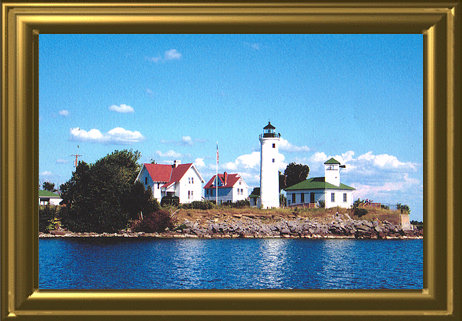
I can't quite believe it either, but it is true: I ran the Tibbetts Point 10K yesterday in the blistering heat. 72 minutes. Slow, but done. Without my sister-in-law to encourage me, I think I would have quit, but she ran by my side. Meanwhile, our spouses, the Morgan brothers, came in first and third in their age category. The beloved toddler proudly wore her daddy's third place ribbon all afternoon.
Wednesday, July 13, 2005
52 Tavistock Square
A couple years ago, Rose Norman sponsored a trip to London for American students of Woolf. You can still find her syllabus online. Here is how she describes Virginia Woolf’s home on Tavistock Square, where Woolf lived during the height of her powers and fame (1924-1939) for a walking tour of London:
Last summer, I had drinks in the Tavistock Hotel and then, at the end of the Woolf conference, stood in the drizzle with many others to watch great Woolf scholars (Gillian Beer, Hermione Lee), Woolf’s nephew, Leonard (a lovely man and very like his uncle in the face), and others unveil a bust of Virginia Woolf there. It was a happy day. I felt that Woolfians (especially Stuart Clarke and others in the Virginia Woolf Society of Great Britain) had reclaimed a bit of London Woolf had loved from the hands of bombers. Our work is, alas, far from done.
I have been reading and watching responses to the London bombings with an averted gaze: Dave has compiled thoughtful ones, Genevieve chimes in with moving grace and led me to McEwan’s piece in the Guardian. Even as I try to finish my own book on Woolf, as I remind myself to carry on her declaration that “thinking is my fighting,” not to cease from mental fight, I have felt more like the writers Orwell describes in “Inside the Whale”: wouldn’t it be nice to be swallowed up, Jonah-like for a while and then emerge a prophet rather than to live through this. On the 7th, the Woolf listserv’s 500 subscribers were abuzz with anxiety and concern for Tavistock Square and, most movingly, for our friends in and near London: Stuart, Lisa, Gina—please email and assure us you’re fine. They did and they are, thank God, but I think of the dozens of other families and networks of grieving friends, of people still living but with lives forever changed because of the bus they caught or did not catch that morning.
Readers of Zadie Smith’s White Teeth or McEwan’s Saturday may be less surprised that last week’s horrific attacks on London’s public transit system seems to have originated from homegrown terrorists. That this is so only underscores how little our leaders (Blair and Bush, that is) seem to know about how to combat terrorism.
My own work this week has taken me back to Three Guineas (1938), a Woolf text I have never liked but always admired. When the book came out, on the eve of WWII, Woolf’s friends and family criticized her for advocating peace in the face of Hitler. They may have been right. But there is a major piece of her argument that we would do well to listen to today: she reminds us, over and over again that the enemy we seem to see abroad lives within us, in our midst, that we must fight the spirit of tyranny everywhere, even on the most apparently small scale, even—and especially—in our own families. I am not smart enough to translate that idea into terms of this grisly “war on terror” just yet, but I do think we can return to Woolf for thoughts on this.
If, hungry for peace, you long to see images of the still extant homes of Virginia Woolf, there’s no better starting place than Elisa Kay Sparks’ comprehensive website. The PowerPoint of Virginia Woolf’s Homes and Gardens is great. She took the photos herself and is generous enough to share them with anyone who is interest but, for obvious melancholy reasons, there are no images of Tavistock Square.
- The Bloomsbury house Woolf lived in the longest, and where she wrote most of her novels, was destroyed in WWII and replaced by part of the Tavistock Hotel.
- #52 was on the south side of the square, three houses from Southampton Row.
- On the west side of the square are houses similar to it.
- At 52 Tavistock Square, Virginia and Leonard lived on the top two floors, with a firm of solicitors on the ground two floors, and the Hogarth Press in the basement, where Virginia also had a writing room.
- Tavistock House, on the east side of the square was the home of Charles Dickens (1851-60) and was where he wrote Bleak House (1852-53), Hard Times (1854), and A Tale of Two Cities (1860-61). Now rebuilt, this is the current home of the British Medical Association.
- From Tavistock Square, turn left into Tavistock Place and walk down to Hunter St.
Last summer, I had drinks in the Tavistock Hotel and then, at the end of the Woolf conference, stood in the drizzle with many others to watch great Woolf scholars (Gillian Beer, Hermione Lee), Woolf’s nephew, Leonard (a lovely man and very like his uncle in the face), and others unveil a bust of Virginia Woolf there. It was a happy day. I felt that Woolfians (especially Stuart Clarke and others in the Virginia Woolf Society of Great Britain) had reclaimed a bit of London Woolf had loved from the hands of bombers. Our work is, alas, far from done.
I have been reading and watching responses to the London bombings with an averted gaze: Dave has compiled thoughtful ones, Genevieve chimes in with moving grace and led me to McEwan’s piece in the Guardian. Even as I try to finish my own book on Woolf, as I remind myself to carry on her declaration that “thinking is my fighting,” not to cease from mental fight, I have felt more like the writers Orwell describes in “Inside the Whale”: wouldn’t it be nice to be swallowed up, Jonah-like for a while and then emerge a prophet rather than to live through this. On the 7th, the Woolf listserv’s 500 subscribers were abuzz with anxiety and concern for Tavistock Square and, most movingly, for our friends in and near London: Stuart, Lisa, Gina—please email and assure us you’re fine. They did and they are, thank God, but I think of the dozens of other families and networks of grieving friends, of people still living but with lives forever changed because of the bus they caught or did not catch that morning.
Readers of Zadie Smith’s White Teeth or McEwan’s Saturday may be less surprised that last week’s horrific attacks on London’s public transit system seems to have originated from homegrown terrorists. That this is so only underscores how little our leaders (Blair and Bush, that is) seem to know about how to combat terrorism.
My own work this week has taken me back to Three Guineas (1938), a Woolf text I have never liked but always admired. When the book came out, on the eve of WWII, Woolf’s friends and family criticized her for advocating peace in the face of Hitler. They may have been right. But there is a major piece of her argument that we would do well to listen to today: she reminds us, over and over again that the enemy we seem to see abroad lives within us, in our midst, that we must fight the spirit of tyranny everywhere, even on the most apparently small scale, even—and especially—in our own families. I am not smart enough to translate that idea into terms of this grisly “war on terror” just yet, but I do think we can return to Woolf for thoughts on this.
If, hungry for peace, you long to see images of the still extant homes of Virginia Woolf, there’s no better starting place than Elisa Kay Sparks’ comprehensive website. The PowerPoint of Virginia Woolf’s Homes and Gardens is great. She took the photos herself and is generous enough to share them with anyone who is interest but, for obvious melancholy reasons, there are no images of Tavistock Square.
Tuesday, July 12, 2005
“another emotional flyover”
That’s how a reporter for the Utica Observer-Dispatch described the flyover of two F-16 fighter jets during the post-race party on Sunday. And I agree. I was fighting back tears and my husband says he was, too. But why? In her anti-fascist pamphlet Three Guineas (1938), Woolf wrote:
Even as I was moved, I thought about this sentiment. I hear the national anthem as a huge flag is slowly raised on the brewery’s brick wall; overhead, a crane suspends a new GM car, honoring the new sponsorship of the race; the men who’ve just raised the flags set off some fireworks as Nik and the Nice Guys break into John Mellencamp’s “R-O-C-K in the USA.” The F-16s appear from nowhere 38,000 people, a quarter of whom are sweaty from having just run over nine miles, raise plastic glasses of free beer in salute. And this moves me to tears. Why? Is it just the heat and beer?
I hate this war. I worried it was a mistake when it began and now I am sure it was one. I hate war; I am more of a pacifist every day. I feel wrenching sorrow that more terrorist violence has struck, now in London, and in Tavistock Square, where a bust of Virginia Woolf accompanies another of Gandhi, where the Woolf’s lived until they lost their home to a German bomb in WWII.
So what moves me is not the power and threat of violence. But I am moved by the noise and power of the planes. By the idea that pilots high above, with skills I’ll never possess, fly over a huge, happy peaceful, motley gathering in salute, that they flip and turn and flick their lights. I am moved by the goofiness of it all, the joy. I am proud to live in a country that can make cool airplanes even though I hate the martial impulse that drove the ingenuity. And, American that I am, I am touched (I don’t know what the right word is for this) by the capitalism of it all: the car on a crane, the common odd marriage of something that seems to have no profit potential (running down a road) and the effort to capitalize. And, though this wrecks whatever shreds of liberal credibility I may still have, I am impressed—just impressed—by the wealth—the literal wealth but also the wealth of human energy and dedication.
On Friday before the race we went down to pick up our registration packets in the rain. Our nephew (age 3) was running a little quarter-mile race on Saturday. Registration for that was first-come, first-served, and opened at noon. We arrived at 11:58 and were 633rd in line for 2,000 slots. Thousands of people were wandering the muddy grass of the Masonic Home, picking up their packets and getting ready for the race. “It’s a fascist dream, a communist dream, all these people eager to get in line to show their fitness,” remarked my husband. We laughed, but that’s not quite right. Everyone has their own idea of the race: winning, beating a friend or their own time from last year; everyone has even their own outfit, their own crazy homemade t-shirt honoring or celebrating some little fact about them and their group (I ran in a "Running with Jim" t-shirt, emblazoned with a photo of my father-in-law in 2000--deeply not-me, but to do otherwise would have been churlish); everyone has their own way of running. It’s a friendly, crazy, chaotic mess. That’s another part of what moves me. I rarely enjoy being in a big crowd, but the Boilermaker is such a time.
Let us never cease from thinking—what is this ‘civilization,’ in which we find ourselves? What are these ceremonies, and why should we take part in them? Where in short is it leading us…?
Even as I was moved, I thought about this sentiment. I hear the national anthem as a huge flag is slowly raised on the brewery’s brick wall; overhead, a crane suspends a new GM car, honoring the new sponsorship of the race; the men who’ve just raised the flags set off some fireworks as Nik and the Nice Guys break into John Mellencamp’s “R-O-C-K in the USA.” The F-16s appear from nowhere 38,000 people, a quarter of whom are sweaty from having just run over nine miles, raise plastic glasses of free beer in salute. And this moves me to tears. Why? Is it just the heat and beer?
I hate this war. I worried it was a mistake when it began and now I am sure it was one. I hate war; I am more of a pacifist every day. I feel wrenching sorrow that more terrorist violence has struck, now in London, and in Tavistock Square, where a bust of Virginia Woolf accompanies another of Gandhi, where the Woolf’s lived until they lost their home to a German bomb in WWII.
So what moves me is not the power and threat of violence. But I am moved by the noise and power of the planes. By the idea that pilots high above, with skills I’ll never possess, fly over a huge, happy peaceful, motley gathering in salute, that they flip and turn and flick their lights. I am moved by the goofiness of it all, the joy. I am proud to live in a country that can make cool airplanes even though I hate the martial impulse that drove the ingenuity. And, American that I am, I am touched (I don’t know what the right word is for this) by the capitalism of it all: the car on a crane, the common odd marriage of something that seems to have no profit potential (running down a road) and the effort to capitalize. And, though this wrecks whatever shreds of liberal credibility I may still have, I am impressed—just impressed—by the wealth—the literal wealth but also the wealth of human energy and dedication.
On Friday before the race we went down to pick up our registration packets in the rain. Our nephew (age 3) was running a little quarter-mile race on Saturday. Registration for that was first-come, first-served, and opened at noon. We arrived at 11:58 and were 633rd in line for 2,000 slots. Thousands of people were wandering the muddy grass of the Masonic Home, picking up their packets and getting ready for the race. “It’s a fascist dream, a communist dream, all these people eager to get in line to show their fitness,” remarked my husband. We laughed, but that’s not quite right. Everyone has their own idea of the race: winning, beating a friend or their own time from last year; everyone has even their own outfit, their own crazy homemade t-shirt honoring or celebrating some little fact about them and their group (I ran in a "Running with Jim" t-shirt, emblazoned with a photo of my father-in-law in 2000--deeply not-me, but to do otherwise would have been churlish); everyone has their own way of running. It’s a friendly, crazy, chaotic mess. That’s another part of what moves me. I rarely enjoy being in a big crowd, but the Boilermaker is such a time.
Monday, July 11, 2005
MIT Weblog survey
Thanks, Saralynn for the tip. If you haven't done it, think about doing the survey now. It'd be good to have lots of women and book bloggers counted:

The Boilermaker
So, I ran the 5K training run (untimed) on Sunday morning and then stood near the finish line to watch the real runners complete the 15K. I am no runner nor am I an athlete but I have run the Boilermaker twice and will run it again next year or the year after and then, well, as long as I can. It’s a great event.
I ran my first Boilermaker, also my first race, in 1998 when I was engaged to marry my husband. His father had run the race since its inception and was running one last time with terminal cancer. In 1999, we married and a couple months later he died. In 2000, the race was dedicated to his memory and I ran it again. But it was too much for us: too much filial duty, too much training, too much of an extra challenge in summers that were often spent moving, gearing up for job applications, working on our books. Now, we’re back and I see once again why it was, for my father-in-law, the highlight of the year.
The Boilermaker is the largest 15K in the country. Over 9,000 people ran it yesterday. It attracts elite runners, who finish in 43 minutes (for Gilbert Okari, the male winner) or 50 (Sally Barsosio, the fastest woman), and striders like me, who run a 10-minute miles or slower. (I was proud to do the 5K in 34 minutes; in 1998, I finished in 97 minutes [that’s a turtle-like pace of 10’37’’/mile].) It is moving and incredible to be able to participate as a competitor in an event with Olympic-caliber athletes. But that is only part of it. This is the city of Utica’s cornerstone event. There isn’t a part of the course without music. Even on the 5K, which began at 7:30 AM, I ran past at least four small bands—from a 20 person pipe and drum corps, in kilts and all, to a five-man heavy metal band—and maybe a dozen huge speakers blasting inspirational songs: Shania Twain’s “Honey I’m Home,” as you round the final turn, or that perennial hockey-game instrumental, or, on a tinny boom box, the theme from “Rocky,” or, near the retirement home, really fast polka music. At one spot, four elderly Shriners, in fezes and all, were keeping time on drums to the beat some very young alt-grunge rockers catty-corner from them.
The race ends in the courtyard (really an enclosed loading dock) of Matt’s brewery (they make Saranac & Utica Club) with popsicles, orange slices, and free beer for runners. There were 38,000 people at the party yesterday, all dancing and drinking on a bright Sunday morning to a merry, serviceable cover band and then doing the guess-where-the-winner’s from guessing game as Kenyan after Kenyan came up to the podium to accept prize money (10 of the top 11 male finishers were Kenyan). The hangover from a morning of drinking free beer is fierce, but, once a year or so, it’s certainly worth it.
Tuesday, July 05, 2005
New Yorkers: Casting the First Stone
We spent the Fourth at the St. Lawrence River. Running along the road (a two-lane highway), a car came towards me and I thought, “Ack! These New Yorkers, up for the weekend!”
Imagine my distress to realize that, in fact, we had become that worse thing: folks up from the City with New Jersey plates!
But how did I know they were New Yorkers? Figuring this out got me up a big (to me hill) and through much of my 3 mile run (a good thing, as I’m running, so I’m told, a 5K race on Sunday): When I late model American sedan in navy, black or white (black interior, of course) drives toward me and I can see inside a dark-haired woman in her forties with shoulder-length locks and a straw hat in the passenger seat and a man with short hair (perhaps a white baseball cap with a navy brim) and a collared shirt (polo or sport shirt), I know they’re New Yorkers getting away for the weekend.
The greatness of Google
I’m working feverishly to finish my book manuscript (a September 1 deadline looms) and couldn’t find a phrase I wanted: at some point in the thirties, I know, Virginia Woolf wrote “Thinking is my fighting.” But when? How could I find it quickly?
That’s when you see what is great and greater about google. I just put the phrase and Woolf’s name in, and up pops this link, to a book review from five years ago in the Times and I can quickly cross check it with my edition of the diary and be done.
Subscribe to:
Posts (Atom)

 Posts


