Wednesday, May 05, 2010

Pilates

Some goals languish; some taunt us, always far in the distance; some, we abandon; others, we meet. Whatever else I can and cannot say about this research leave, I have met my goal of exercising 4 or 5 times a week. 
As surprising as that is, my new obsession with Pilates surprises me more. Perhaps it shouldn’t. I flinch when a ball comes my way, so ball sports are out for exercise. I have an intense love-hate relationship with running. My body is not built for the jumping around of aerobics. Having grown up in Seattle in the 70s, I had my share of yoga-like experiences as a kid, lying on the floor in a gym, listening to the sounds of the Orca, suppressing giggles; leaning forward practicing my deep breaths while the young undergrad grazed my newly sprouting breasts under the guise of improving my technique. I like yoga a lot, but I often smell ulterior motives.

I’m sure there is lousy Pilates, too, but I’ve been lucky so far. I love the story of its founding as a method for rehabilitating WWI veterans. From the outset it welcomes broken and bruised bodies, promising some therapy, some relief. Plus, it attracts retired dancers, and I used to adore the modern dance classes I took as a child. All that technique, all the specialized vocabulary, all the concentration: I have found it again in Pilates.

So, I go once a week to the PilatesHaus and take a mat class. I do a video at least one other day. Even without the equipment—which is really fun but too expensive for anything but a treat—every exercise depends on five or six isolated muscle contractions at once. The more you do it, the more challenging the exercises become. At first, you’re just doing a fancy sit up; only later can you make that c-curve with your spine, press your inner thighs together, lower down one vertebrae at a time, keep your ankles together and toes apart, all while pulling down on your lats and pushing your belly button in to the base of your spine. All these instructions, spoken as gentle reminders, “Shoulders in their sockets, Anne,” are immensely reassuring to me. I can’t think about anything other than Pilates when I do Pilates, and, an hour later, I’m taller and happier.

My mom reminds me that I struggled and struggled to learn to skip when I was 5 or 6. Finally, she asked my dance teacher, the amazing Martha Nishitani, to help me. “One knee up; the other knee up,” she explained, and I was skipping in no time. I am indeed a verbal learner. Strangely enough—though perhaps, not so strange, as my teacher needs me to keep coming back—two of my three teachers so far have told me that I’m actually pretty good at it. I’m embarrassed at how I cling to these compliments, and yet I’m beginning to think that it may not only be flattery or the desire to keep a paying client. Maybe I am kind of good at this. Who knew?

The videos of Joseph Pilates training people are wonderful curiosities, but you can see Brett, the co-owner of the studio I go to, here, and you can see how cool it would be to get that good. 

Tuesday, May 04, 2010

Safe Space and H.O.W. Fundraiser and Art Auction


This Thursday, the literary journal H.O.W., for which I am on the board, is having its spring fundraiser and it looks to be a great one. The fantastic Roxana Robinson, author of Cost, will be reading and they’ll be auctioning off a bunch of art, including some really amazing looking t-shirts featuring the prose of Jonathan Ames, Amy Hempel, Rick Moody, and Honor Moore.

H.O.W. is not just a journal, it also functions as a nonprofit to raise money and awareness for children. This season, once again, money will go to Safe Space, an NYC nonprofit that works with children and youth in the foster care system.

I am so sad that I can’t go to this event, but if you’re looking for something cool and literary to do for a good cause on Thursday night, why not check this out. Student tickets are only $10—don’t forget your id!

Friday, April 30, 2010

Into the Well


I was on the phone with a colleague the other day and he asked how my leave is going.

I groaned. He laughed. He told me that when he’d seen our colleague for the first time, back at work after a year’s research leave, he looked like he was still at the bottom of a deep well. We both laughed and then we talked about the well for a while.

I like that metaphor because that is what it feels like when I spend the day in the library. It doesn’t take more than three or four hours for me to turn into a disoriented, blinking mole, shocked at the clamor and noise of the world around. When I get deep enough into my work to actually break ground—which is rare—it can be hard to return to family life. Most days, however, I have to be so conscious that I need to leave at 4:30 in order to fetch the girls that all I do is peer down into the well, imagining what I might find in the distant darkness.

Peering down isn’t enough, however. If you want to find the treasure that lies beneath the surface, you have to dive down into the well.

Merry little magpies like me find many reasons to peck around at the ground instead. The sky is blue. The children are charming. Smart friends and acquaintances are tweeting away, updating statuses with wit and energy. Why leave this happy conflagration for the mysteries of the deep?

Because the treasure is at the bottom of the well.

Thursday, April 22, 2010

Research


This stretch of research leave marks the first time since my children were born (more than 7 years ago) that I have had hours to spend in the library poking around. I thought I’d left it behind—worried, even, that I wouldn’t want to be a scholar anymore--but, though the muscles have atrophied, I am gaining strength again and returning to that delicious sense of pleasure in going deep, deep, deep into a bit of reading to see if there’s anything there. I like almost every bit of it: the silence, the mental effort of reading a theoretical essay, the pleasure of skimming something that, in the end, doesn’t fit, and, to my point today, ferreting out little bits of historical research.

Today, after a couple hours of responding to colleague’s writing, I rejected a tedious project (collating editions has still not risen to the place of pleasure. When it does, I think I will have achieved Boddhisathva-hood)—the one I really should do—in favor of opening the cardboard box on my shelf. What was inside?

A bound black volume with COMMERCE TLC p.v. 126 stamped on the inside masked an imperfectly bound collection of pamphlets. How these 12 documents came to live together, I don’t know—and I’m smart enough not to get distracted by the desire to find out. I called this out of its dusty home to consult No. 8: London Municipal Society and National Union of Ratepayers’ Association. The Greater London Traffic Problem: A Scheme for Its Solution. No. 18. London: London Municipal Society. n.d. stamped 1923.

There is some talk in Mrs. Dalloway, in several spots, about London traffic. Most germane for me, Richard Dalloway thinks that something should be done. It occurred to me that a committee on traffic reform is just the kind of thing Richard Dalloway, MP, might be on. Was there such a commission?

Well, it turns out that traffic lights were introduced in London between 1923—when the novel is set—and 1925—when it’s published. So I called up the pamphlet in case it said something about this innovation. It is silent on this score. Instead, for 11 pages, the authors describe all the competing interests and stakeholders in the problem and summarize the reports of other commissions and committees. Unlike other traffic-related documents which mention specific intersections or the problems with buses, say, or pedestrians crossing multi-lane roads, this one never stoops below the level of bureaucracy to describe the street.

How, then, did No. 8 come to be bound alongside No. 2 “Sorelle, R.P. and J. R. Greeg…Teacher’s manual to Secretarial studies (1923)” or “No. 6 “U.S. President, 1801-1809 (Jefferson)..Message transmitting a memorial of the merchants of Baltimore, January 29th 1806” or No. 12 “Review of the commerce of New Orleans. For 1875-76” which begins “The hopes of the trade, freely indulged in last September, have not been altogether fulfilled.”

Indeed. My hopes—for pamphlets on municipal traffic or otherwise—are seldom altogether fulfilled. I will say, however, that it is quietly thrilling to learn that I still really do like the scholar’s life. I just hope there will be more of it again some day.

Tuesday, April 20, 2010

Lizzie Skurnick for Girls Write Now

I’ve encouraged you all to go to the Chapters Readings before, and Friday brings another chance. The wonderfully smart and funny Lizzie Skurnick will be reading from her new book, Shelf Discovery: The Teen Classics We Never Stopped Reading (2009). Lizzie’s book is a love letter to some of the great young adult fiction of the seventies, much of it by women and about real girls facing real and interesting problems: the very books that I hope the girls of Girls Write Now discover and find refuge in. My mother-in-law and I devoured the book together last summer, reminiscing about all the books we had loved and the ones that had meant so much to her 9th graders back when she was teaching. Reading with Lizzie will be some of the teen girls and their mentors who are participating in Girls Write Now this year. Here is the roster:
  • Emily Alvarez, "I Write for a Reason"

  • Michaela Burns, "Red Apple Pie"

  • Tianna Coleman, "Who am I: An Ode to Precious"

  • Clio Contogenis, "Mary Ellen, Nana Mary"

  • L’Eunice Faust & Tasha Gordon-Solmon, "If God Had Made Eve First"

  • Rachel Garcia, "The Yellow Dress"

  • Dalina Jimenez & Corey Binns, "Welcome Home"

  • Ceasia King & Ariana Proehl, "Ego Trips (We Know Exactly Why)"

  • Syeda Showkat & Kirthana Ramisetti, "Nora and Carol at the Discount Plus Christmas Party"

  • Shannon Talley & Jen McFann
Pamela Vasquez, "Bark Bark Roof Bark"

  • Quanasia Wheeler & Cynara Charles-Pierre, "The Yum that Keeps Giving" & "Thanksgiving No More"
I’ll confess that the first time I went to a paired reading, my heart sank a little at the length of the program. But, trust me, the women of Girls Write Now are fierce and organized: the readings are snappy, and the girls will have you laughing and crying. It’s the kind of event to make you remember why all the work we do, all the love we have, for literature really counts.

The event happens at the wonderful Center for Fiction (17 E 47th), this Friday from 6:00-8:00. I will be there & I hope to see you, too.

P.S. It’s not too late to apply to be a mentor for 2010-2011.

P.P.S. Finally, whether you’re in New York or not, you can pretty up your home and help the cause by buying one of (Seattle’s own) glassybaby votives/vases. Stop by their beautiful New York shop (in Jane Jacobs’s old house!) at 55 Hudson Street or just enter the code GWN on their website. (You can also just donate to Girls Write Now through the Network for Good here.)

These are the prettiest candleholders ever. Our apartment is FULL of them and I cannot get enough.

Monday, April 19, 2010

A happily married woman

For me, one of the chief differences between what I call middlebrow fiction and literary fiction has to do with the degree to which the writing announces itself as writing. It’s impossible to fly through a Woolf novel for the plot: not only are her plots thin, almost event-less in the ordinary, outward sense, but her writing demands your attention. That’s fact—the poetry of Woolf’s prose—has sustained my interest in reading, studying, and writing about Woolf for two decades.

But I also like to read another kind of book, a book like Dorothy Whipple’s Someone at a Distance, where the writing is clear and strong and full of careful and apt description but all of that is in the service of telling a story, of exploring how these fictional characters will react to the situations she has imagined for them.

As I said yesterday, most of Someone at a Distance is written with an Orwellian clarity: prose like a windowpane. There are no missteps, no groaners. And there are a few moments of really beautiful prose. For me, these two paragraphs on how a wife comes to rely on a happy marriage were among the most poignant in the book: beautiful, funny, and smart. They come half way through, just before that happy marriage must endure a brutal test, and, knowing what is coming (the hints are strong), the description has all the more power:
A happily married woman acquires the habit of referring everything to, discussing everything with, her husband. Even the smallest things. Like bad coal, for instance. To be able to say, sitting across the hearth from him in the evening: ‘Isn’t this coal bad?’ and to hear him say, looking up from his book at the fire: ‘Awful. Sheer slate,’ is to have something comfortable made out of even bad coal. 
            A loved husband is the companion of companions, the supreme sharer, and a happy wife often sounds trivial when she is really sampling and enjoying their mutual and unique confidence. But in doing it, she largely loses her power of independent decision and action. She either brings her husband round to her way of thinking or goes over to his, and mostly she doesn’t know or care which it is. (210-11)
I love the mid-century, English specificity of bad coal. I don’t know what “sheer slate” means exactly—though we can easily guess the discomfort of a fire that’s not warming us as it should—but it’s funny how right it sounds, even 60 years later: that’s just what one is supposed to say. And Whipple is right to notice how a shared complaint, a regular one against some domestic inconvenience, can reconfirm domesticity in a lovely way. Also wonderful—and characteristic—is the gentle feminist turn in the second paragraph. I feel my own trivialities to be understood and forgiven in that description of how such details are really a “sampling and enjoying” of intimacy. And yet, as Whipple warns, there is a danger—a very specific one—to too much of this. Spending too much time luxuriating in the “us” of a marriage, one risks losing oneself.

Yet, moments later, when Ellen must make a decision without consulting her husband, she “felt she was breaking one of the countless Lillputian bonds that bound her up with Avery.”

One of the challenges of marriage is finding the right balance between coupledom and independence. Clarissa Dalloway manages it by marrying a man who leaves her to be independent; Ellen North chooses to lose herself in a man and, when he shows himself less worthy, she must begin to forge a new life by untangling herself from the webs of the old. What’s lovely in Whipple’s writing here is that she takes the time to describe what it is that Ellen, who seems so plump, ordinary, and sweet, has at stake—to lose and to gain.

Sunday, April 18, 2010

Another Persephone Book

Once a month or so, my mom asks me “Have you read Someone at a Distance yet?”

So, when I packed my suitcase to go to Seattle for Easter, I popped Someone at a Distance in my bag, confident that her presence would prompt me to get started on the book. It did and I have. What a lovely novel.

Dorothy Whipple’s 1953 book, reprinted by the amazing Persephone Books, is a really lovely, quiet, devastating bit of domestic fiction. Ellen North, the sweet and generous 43-year-old wife, is at the book’s heart, but the omniscient narration keeps her at a distance. And those very English, decorous distances are a theme of the book, beginning with the twin beds, three feet apart, that furnish the bedroom she shares with her husband Avery. Distances can signify comfort or discord and they do both here.

The book explores the devastation that just one unhappy person can wreak on the lives of the contented middle class. At first, that unhappy person is Ellen’s mother-in-law, a widow who feels that she is far from getting her due in attention from her son, daughter-in-law, and their two teenage children. But, when Mrs. North hires a French girl to live-in as a companion, the plot really sets in motion: Louise's unhappiness is the serpent in Mrs. North's beloved suburban garden.

For the long, slow (but not dull) first half of the book, Whipple spools out, Louise’s grudge against the world and her icy quest to get her due alternating with Ellen’s happy, middle-aged contentment in her garden, her marriage, and her growing children. When Louise finally strikes, the devastation is swift and total. From there, the plot picks up, and the denouement is every bit as riveting as the exposition.

The writing is straightforward, not showy but always apt. There are some occasionally really elegant and deft phrases and Whipple goes into the motives and reactions of each of her characters, major and minor, with tremendous sympathy. The book is a masterpiece of middlebrow fiction: not aspiring to the status of literature, but miles better than most plot-driven psychological novels that keep your local Borders stocked and your neighbors’ reading groups talking. This would be a wonderful book to talk about with a friend.

Or your mom. I’m waiting for mine to call me now so we can…

Monday, April 12, 2010

The Kindle, Again

My dad surprised me with a Kindle for my birthday about six months ago. I was thrilled, but, truth be told, I haven’t used it nearly as much as I planned to. I downloaded a raft of free classics right away and even re-read This Side of Paradise on the PATH train.

To be honest, however, the prospect of reading Kant on the Kindle on the morning commute is a little bit of an uphill climb. I haven’t done it.

Fitzgerald, to be sure, is less of a challenge and I fared better with him. Still, I found the Kindle made my novel reading a little more scattered—somehow, and in spite of that %-read sign down below, I found it more difficult than usual to keep track of the plot and where I was in the arc of the story. On the plus side, however, I was really tickled when I belatedly remembered there had been some business about a taxi in the book and could simply search “taxi” and find each appearance of the word. It’s too bad that, when I go to write about it, there’s no easy way to translate the %-read or page marks to page numbers in a print edition, but I can do that by hand, no doubt. In fact, that %-read sign distracts me and eggs on my competitive side.

That is just part of what I thought from the beginning: that the Kindle really would be ideal for reading bestsellers: ephemeral books of the moment, books that are more fun to read when they come out but that you may not want or need to own in a personal library.

At dinner in Seattle last week, our friends both raved about Mark Halperin and John Heilemann’s Game Change. Since I was traveling (with my Kindle and a lot of books), it made sense to download it and I’ve just loved reading it. The book is really fun: well-written, full of gossip, and fast-paced. As long-time readers here know, I was really engaged in the 2008 election and my taste for hearing about it has not slackened. But reading along on the Kindle, and watching myself rise from 22% done to 35% done, has made the reading itself into a race just as merry as reliving the election (without all the angst and worry about the outcome this time around).

So, I have renewed enthusiasm and purpose for the Kindle. I’m always really interested in those nonfiction books that people devour fast and I love to read them fairly soon after they come out, so the Kindle can be my spot for that.

There are so many different kinds of reading: some really do require a lovely edition, others are just fine online, others—somewhere in the middle—look to me like they’ll work great on an e-reader. 

Wednesday, March 31, 2010

Heavy Stack, Light Blogging

One happy consequence of the fact that I’m writing scholarly stuff again is that I’ve read a bunch of books which I want to tell you about—or compose my thoughts out loud about—and I haven’t had the chance. So I have this stack of books that I carry from my bedroom to the dining room (where I work), from a corner of a hidden shelf, to out in the open without actually composing the posts.

So, as a kind of teaser, here is the stack:
  • Teaching Community by bell hooks (purchased in Louisville at the CCCConvention last weekend)
  • Push by Sapphire (which I loved)
  • Trailer Girl by Therese Svoboda (the title novella of which is utterly stunning, though the stories that follow are less even)
  • A Coffin for Dimitrios by Eric Ambler (a great classic thriller)
  • Bird by Bird by Anne Lamott (which is really weird and disappointing)
  • A Guide to College Writing Assessment (O’Neill et al., another CCCC purchase, but one I’m unlikely to blog about here)
  • Some small press catalogs
  • And my comments on a couple dozen essays nominated for the upcoming edition of the Norton Reader

Maybe some of these will get a post of their own one day. But for now, I’m going back to the stacks—the Woolf stacks, that is. Time’s a-wasting.

Tuesday, March 30, 2010

The Wertheim Study

“I’ve made us a cup of tea.”

Can there be any nicer sentence in English? When you meet someone for the first time, how lovely to already have that person caring for you.

When I knew I had a research leave coming up, I applied for one of those very amazingly fancy New York Public Library Fellowships. I didn’t get one; I didn’t expect to. But I did root around the website and found that, much less competitive than a fellowship were the two study rooms, the Allen (for people with book contracts) and the Wertheim (for scholars). I asked if I could have a space and was put on the waitlist.

Then, in February, I got notice that a space would come open on March 1. Could I fill out a form and come in for a chat?

I was nervous, but Jay Barksdale, the wonderful librarian in charge, put me at ease immediately with the aforementioned cup of tea in a real china cup with saucer. Really, the point of the meeting was just to make sure that I knew the rules and the procedures, but how many times nicer to learn about all of that with a cup of tea in hand.

What are the rules? I have a special electronic key card, but the room is open whenever the library is. There are special call slips for the Wertheim, too. Many, many people have access to the room—and, more to the point, the shelf where I can keep—yes, keep—any books that I need to use for my project, though the room really only comfortably seats about 15 at a time at its 3 wonderful long tables. And, to my immense narcissistic pleasure, I was asked if I would be willing to speak to, say, the New York Times, should they have an urgent need for a specialist. (Urgent needs for Mrs. Dalloway specialists being rare, I am not expecting a call.)

The Wertheim and Allen rooms run a series of lectures by the scholars at work there at the Mid-Manhattan Library (catty-corner from the big NYPL) many evenings at 6:30. Here is one upcoming event. And you can become a fan of the rooms  on facebook, which is a good way to learn about upcoming and recently past lectures.

I cannot describe to you how much of a difference this space, full of silent scholars (when people sneeze, no one even says bless you!) hard at work on projects. But the light posting here since March 1 is perhaps the best indicator of the fact that I’m not just “writing” in quotes, I’m writing.

One more cool thing: the room was established by author and scholar Barbara Tuchman. Isn’t that awesome?

Here is the official description:
To assist researchers making intensive use of the general research collections for a prescribed period of time, The New York Public Library has made available the Wertheim Study.  Established in 1963 by author and scholar Barbara Tuchman in honor of her father, Maurice Wertheim, publisher of “The Nation” and a founder of The Theatre Guild, the Study serves individuals engaged in research projects requiring extensive consultation of research materials related to the humanities and social sciences, preliminary to the preparation of a publication, report, or other research project. 

Monday, March 29, 2010

Black Hair


“Um…thanks, Anne.” That was Allison Keyes’ response to my taped comment to her really fierce essay about how much she loathes having her hair touched.

Yup, I know. Fernham is not exactly your source for thoughts on black hair. Believe me, I know the limits of my expertise. But I was listening to Tell Me More last Monday. Guest host Allison Keyes read an essay about why she hates having her hair touched—and how often people touch it. It was far from the usual NPR fare: she was still imagining a mainly white audience, but she wasn’t gently helping her audience understand. She was irritated. And she meant for us to identify with her irritation.

I liked it so well, that I fired off a quick email comment to the show. I was one of 400+ people to do so. Imagine my surprise, then, to get an email from producer Lee Hill. Could he call me to record my comment?

Frankly, I was very surprised but mostly thrilled. Here is what I said:
Thank you so much. I am so enjoying your great piece on touching hair and just wanted to add a tiny little footnote that might amuse you: I am a 43 y.o. white woman. I grew up in Seattle where I was bused for voluntary desegration but my middle school bus was racially integrated. I'll never forget the day when a black boy pulled my long, straight hair out and passed it round as "white girl hair." It was funny. It hurt. I got it. I never touch anyone without asking. But I get why people are curious. Thanks for a sharp, strong essay.
Hill called me to confirm I had time to talk, called me back on a recording line, and I recorded my comment.

It was really exciting for an NPR fanatic like me and the lukewarm “um, thanks Anne” is thanks enough.

You can hear me here. More to the point, you can hear Allison Keyes’ essay here and learn more about her here.

Tuesday, March 23, 2010

Three Great Ways to Help Girls Write Now


Those of you who read this blog know that I’m a passionate member of the advisory board for Girls Write Now, a New York City mentoring organization that pairs high school girls with professional women writers. If you’re in the New York City and are interested in getting involved, there are 3 great ways you can do it.

1. Listening
Maud Newton is curating the wonderful CHAPTERS reading series, featuring the work of New York City's best teen writers and the professional women who mentor them, and a dynamic, diverse line-up of special guest authors. This Friday, March 26, will feature Nami Mun, author of Miles from Nowhere. CHAPTERS readings will be held at the Center for Fiction (17 East 47th Street bet. 5th Ave. & Madison), from 6:00PM to 8:00PM.

2. Shopping
10% of anything you buy at any of Eileen Fisher’s New York City stores on Saturday, March 27 goes straight to Girls Write Now! You know you want a new skirt! (I’m pretty much head to toe in Eileen Fisher at the Public Library these days. No one makes a more flattering skirt that works for work.)

3. Mentoring
If you’re a professional woman writer, why not apply to be a mentor for the 2010-2011 school year? Applications are here are due by May 1.

And, of course, near or far, a quick click on the Network for Good website will allow you to make a donation.

Wednesday, March 03, 2010

Progress Report

You think you can do these things, but you can’t, Nemo, you just can’t!
March is upon us. My sabbatical is two months old. How has it been going?

  • I continue to be grateful for the time. Every day, I feel blessed to have some of the many stresses of teaching and administrated lifted from me for this spell. But, as each day passes, I feel under increasing pressure to achieve what will feel like a worthy achievement come August. And, of course, removing the pressure of a full schedule has meant that I've caught up on all kinds of time-consuming errands that still do keep me from my writing (dentists and more).
  • I have kept to my resolution of exercising five days a week and I’ve been better than usual at tracking my exercise and eating over at WeightWatchers. But I’ve only lost five pounds. That’s five more than zero, but five less than I’d like to have shed by now.
  • I have made progress on the most odious project of the Dalloway edition: collating changes among editions. But I’m not done.
  • I have begun three new (non-scholarly) essays. But finished none of them. And I’ve read a lot.
And, twice last week while walking the dog, Nemo’s dad’s horrible advice popped into my head unbidden: You think you can do these things, but you can’t, Nemo, you just can’t! Who knows why we are so cruel to ourselves. This version of self-flagellation is particularly hilarious and ridiculous: the whole point of that moment is that Nemo can do these thing, that, in hearing himself limit his child, the father has an epiphany about expectations and limitations. The other problem here is that after 10 years of higher education at top-tier universities, my super-ego can be blockaded by an animated clownfish from Pixar.

I need a new mantra.

Tuesday, March 02, 2010

Advice for memoir writers, c.1923

From Woolf’s letters:
“A little comb and a brush is all thats needed. You know how Clive conceals his bald patch? Well, that’s how to treat your memoirs.” (L 3.41; 21 May 1923; to Molly MacCarthy)
It’s a wonderful quotation. Woolf loved to tease about her brother-in-law, Clive Bell's, bald spot. Still, it’s very odd to hear Woolf, who, with Lytton Strachey, so famously transformed biography from Victorian reverence to modernist honesty, advising her friend to just comb over the truth. I must say, fan of memoirs though I am, I often do wish for a little concealer.

Monday, March 01, 2010

Advice for Writers


Oh, I’m in trouble now.

I finally clicked over to the excellent Guardian compilation of advice for writers. Roddy Doyle’s first rule stopped me dead in my tracks: 
Do not place a photograph of your-­favourite author on your desk, especially if the author is one of the famous ones who committed suicide.
I have to laugh! The bathroom may be the only room in our house without a picture of Virginia Woolf in it. (I have a really good fridge magnet of her…)

Wednesday, February 24, 2010

Tomorrow, I say to myself, I shall plunge into the thick of it.


An amazing gem on the writer’s life, from Woolf’s letters:
“Here we are with our noses to the grindstone. The grindstone is made of innumerable books which have to be transubstantiated into precisely the right number of articles, containing the right sentiments, views and facts, in the right number of words at the right moment. This not once, but weekly, every week, very month, every year—till all our precious time is over, and life, which surely has other uses, has poured in cataracts of printers ink, down the main gutter to the Thames. Perhaps the horror will mitigate. I have had only 4 days writing at my novel [Mrs. Dalloway] since I got back. Tomorrow, I say to myself, I shall plunge into the thick of it. But how does one make people talk about everything in the whole of life, so that one’s hair stands on end, in a drawing room? How can one weight and sharpen dialogue till each sentence tears its way like a harpoon and grapples with the shingles at the bottom of the reader’s soul? (L 3.36; 13 May 1923; to Gerald Brenan)

Tuesday, February 23, 2010

A Movie and a Journey

I’m not quite sure why I still get Parents magazine: it was reassuring when the babies were young toddlers, but I’ve pretty much outgrown it now that they’re 3 & 7. All that advice about pregnancy fitness and how to tell your boss that you’re not coming back to work after all (ha!) or how worried you really should be about the hidden perils of [insert your kid’s favorite food or activity] feels very distant, thank goodness, from my life now.

Still, I was really excited to see a short feature in the March 2010 issue on great foreign films for kids and families. I depend on DVDs for some family quiet time and I’m always looking for cool stuff to show the girls. They got The Red Balloon, White Mane (on one DVD) and Paddle to the Sea (about our beloved St. Lawrence River!) for Christmas. It’s true that they prefer iCarly and Yo Gabba Gabba! (who wouldn’t?), but still, I feel better about screen time if some of it is imaginative and beautiful. (Yo Gabba Gabba is pretty awesome, I must say…)

Less excited to read this, about My Neighbor Totoro (Tonari no Totoro; Japan 1988): “You can explain to your child that the Japanese culture is rich in superstition.”

Really? Is superstition the big lesson about Japan that we’re taking away? I understand that it’s hard to write a “Cultural Highlight” for each of six films in 20 words or less, but I think we can do better than that.

And don’t bother trying to find the list on the Parents magazine website which is so cluttered with ads and surveys that it’s like descending into the Sunday supplement of your local newspaper only to find the comics are missing.

Still, the movies recommend sound great and my girls will be getting a couple for Easter, I think. I wish they had included a Spanish film. I combed the web for suggestions, but all the most popular Spanish films are dubbed Disney movies. I found a big list of Spanish-language films here, and, combing through it, some

Here are the recommendations:
  • My Neighbor Totoro (Japan 1988) best for ages 4+
  • Rabbit-Proof Fence (Australia 2002) 10+
  • Children of Heaven (Iran 1997) 6+
  • The Red Balloon (France 1956) 4+
  • The Cave of the Yellow Dog (Mongolia 2005) 4+
  • Azur and Asmar (The Arabic Middle East [? I have no idea what that means?!] 2006) 6+ (imdb tells me it’s a Belgian film) 

I’d love to hear any others you’d add to the list—Spanish or no!

Monday, February 22, 2010

Household Help

Between The Known World, Wench, and Mrs. Woolf and the Servants, I have spent many, many hours of 2010 imagining slavery and servitude. Let me be very clear in saying that I in no way conflate one with the other. The idea of humans owning other humans is shudderingly abhorrent.

Nonetheless, and among many other things in their books, Alison Light, Dolen Perkins-Valdez, and Edward P. Jones all ask us to focus our imaginations on a small, domestic interior with two women, a master and a servant or slave, and the intense, fraught power relations contained within the smallest gestures. These scenes—in which a slave in The Known World backs up against the wall as she listens to an older woman lecture her newly widowed daughter on the folly of freeing her slaves, in which an infertile mistress fawns over her husband’s children by a slave while the mother must look on stoically—helped me better understand a much more benign but also beloved pair of scenes in Mrs. Dalloway in which Lucy, the beloved maid, and Clarissa, bicker in gestures—that’s the best way I can think to describe it, for no words are exchanged:

And Lucy, coming into the drawing-room with her tray held out, put the giant candlesticks on the mantelpiece, the silver casket in the middle, turned the crystal dolphin  towards  the  clock.

and then, many pages later...

"And how," she said, turning the crystal dolphin to stand straight, "how did you enjoy the play last night? "

Now, the scenes I referenced from Jones and Perkins-Valdez are grand in their significance; this one is in more of a minor key. Even so, through that crystal dolphin—a little gift to Vanessa, whose nickname was Dolphin—signifies the rigidity of the power dynamic between servant and mistress. Lucy likes working for Clarissa and she swells with pride at the thought of how much Clarissa’s guests will enjoy the party. Turning the crystal dolphin is an act of creativity or rebellion, perhaps, but when Clarissa turns it back straight, it’s not a conversation: it’s a power play. The mistress wins.

It’s really Alison Light who reminded me of this detail, for she found a fragment in the Monk's House Papers in Sussex which document Woolf’s own observation of the phenomenon:

“But in Bloomsbury the servants were not victims or drudges, and Woolf noted that even her char moved an ornament on the mantelpiece at Monk’s House to leave it ‘askew’ each day, a symptomatic act which, Woolf imagined, showed the desire for ornament and her thirst for art (it might equally have been an assertion of independence” (151)

I will only add that we hire a woman to come clean—every other week—and one of the first things I do when she leaves is to adjust all the ornaments that she has moved while dusting. I mean no insult in observing that she has a particularly rigid sense of symmetry. My aesthetic is, like Lucy’s, more askew.

Thursday, February 18, 2010

Woolf’s Letters


Well now that’s done and I’m glad it’s over.—T. S. Eliot

I feel a bit like Eliot’s poor typist, home at tea-time and glad to shut the door on the young man carbuncular.

For the past three hours, I’ve been thumbing through a heavily post-it flagged volume of Woolf’s letters, read in July 2009, and typing every quotation therein which might be of use for the Dalloway edition. 

I have found many, many gems: wonderful little tidbits that will make great footnotes. I have learned so much about Woolf’s composition process and her imagination. Woolf’s dressmaker, for example, was called Sally Young; Clarissa Dalloway’s is called Sally Parker. But don’t these two Sallys make you think again about what it means that she chose to call Clarissa’s best friend Sally, too?

That said, I do not like Woolf’s letters.

I would have guessed that the worst of Woolf would emerge in the diary. So often, in articles, a scholar triumphs to demonstrate how a tone-down opinion in a novel or essay is expressed with greater venom (be it snobbery or anti-Semitism or hatred of the poor or horror of bodily functions) in the diaries, that I feared that I’d find the diaries hard going.

In fact, it’s the letters that seem to show Woolf at her worst: snobby, manic, overly eager to please, too clever by half. There are many many wonderful moments to be sure, but there are icky ones too. And I just don’t find icky  moments elsewhere in her work. And the diaries, such private documents, seem to observe a greater sense of decorum than the letters. I think this is so because she was her own audience in the diaries—they are not a special command performance for a friend or her sister—they are a place in which she asked herself to think with precision about an event, a person, or an image.

Wednesday, February 17, 2010

Wench by Dolen Perkins-Valdez


I told my mom to read The Known World, though I hadn’t read it. My mom had been bugging me to read it and I did. Somewhere in the middle of reading it, I read Tayari’s post about Wench and I knew that it was the next book for my mom and me.

Once again, my mom read it first and loved it. Now I’ve read it, too—and already leant it out to a friend.

Wench is based on a real resort in 1850s Xenia, Ohio where slave masters would take their slave mistresses on vacation. The three-part book focuses on Lizzie, one of four women who come together each summer to share stories and struggles. This is a serious novel but also a pleasurable one—it won’t break your heart and pull out your guts the way some other books about slavery do. Instead, it pulls you in to the incredible friendship among women, the way women need to learn to be true to each other and not depend on men.

What Perkins-Valdez does so amazingly is to offer up the story of all the confusing emotions of a young slave, Lizzie, who becomes her master’s mistress as a teen-ager. What is it she feels for him? Can you call it love when your lover owns you? When, on the last day of your “vacation” he ties you to the porch and leaves you a bowl of water like you’re a dog? Of course, it’s not anything we would want to call love, but it makes you think hard—very hard—about human attachments and marriage. Lizzie’s situation is an extreme version of what marriage was for many women for centuries: total economic dependence, lack of property (of course, a slave was property), utter lack of legal stature, utter lack of rights over one’s own body or to one’s children. If that is your situation and you’re still a human, mightn’t you soften a bit? Find some loyalty or affection for an owner who is attached to you? Find some ways to love and mother your children, to figure out—desperately, anxiously—ways to get your lover-owner to promise to free them?

I’m not surprised that this book is getting a lot of buzz (it's in its fourth printing already, last I heard!): it’s a wonderful story about the power of women, of a mother’s love, of friendship. You can read more about it here and here. And, if you're in New York, you can hear her read--and support Girls Write Now while you're at it--on February 26th.

Tuesday, February 16, 2010

Alison Light on voice


The thing that makes—or breaks—a book for me is voice. If its resonant, distinctive, authentic, I am eager to read on. But voice is so hard to describe. It certainly seems tricky to discuss it as a scholar with any kind of theoretical rigor, so I was really delighted by this passage in Mrs. Woolf and the Servants in which Light describes the impossibility of characterizing voice and then goes on to beautifully, carefully, characterize a speaking voice. Here, Light is describing the experience of listening to a series of BBC recordings of the recollections of servants:  
“No matter how patient the transcriber, a voice cannot be written down. Inevitably its flavour and richness is lost…On the page, Happy’s memories of her past read a little flatly…The taped interview, however, is a different story. Happy laughs throughout, a rich, throaty laugh, which often overcomes her, and stops her from talking….Mrs. Sturgeon also laughs every time she mentions a terrible experience. Her laughter ironizes much of what she recalls: ‘oh it was the the most marvelous door!’ she says, tongue in cheek, when she remembers the almost sacred ritual of cleaning the oak front door and the brass door knocker” (298)

Monday, February 15, 2010

Mrs. Woolf and the Servants


As I mentioned last week, I finally read (and loved) Alison Light’s brilliant social history, Mrs. Woolf and the Servants. Light’s book opens with a chapter on Sophie Farrell, the Stephen & Duckworth family cook (and thus the cook of Woolf’s childhood) and then largely focuses on Nellie Boxall, Woolf’s cook for 18 years. Boxall, Farrell, and other servants of Bloomsbury become the occasion for meditating on the phenomenon of domestic service.

Until WWII, most women who worked, worked in domestic service but, understandably, the workers’ rights movements that were arising in the 20th century largely focused on waged labor outside the domestic sphere. Through careful excavation, Light, herself the granddaughter of a domestic worker, imagines the intense intimacies of the Victorian and modern home. (Image: Nellie Boxall; Harvard Theater Archives.)

The book was widely reviewed when it came out two years ago, so you’ve probably read all about it already. Still, the story doesn’t get stale. It’s amazing to think of Woolf growing up in a house where she just took off her clothes and let them fall to the floor, where servants cleaned her chamber pot every morning (how wonderful, I think, that I do not have to sleep near a big bowl of urine! One of the perks of the 21st century.), where she never cooked. Or that, when the Woolf’s hired switched to a daily cook in 1929, it was the first time in their lives that they had been alone in their house.

How very strange to think that: that one would live forty-seven years with an employee, a servant, always in the house. No wonder, I think, that the class of servant-employing British (from middle-class up, say), developed a national character of stiff upper lips and discretion. If someone else knew all my intimate details, everything about my body and its functions, I would develop some secrets in other parts of my life, too.

If you’re interested in others’ opinions on Light’s wonderful book, you might look to Mona Simpson in The Atlantic. I especially admired the way that she flipped the linkage between Orwell and Woolf (which usually goes to Orwell’s advantage) here:
Orwell’s relation to coal production remained abstract, whereas Woolf would see her own dinner cooked, her underwear scrubbed, and her chamber pot from the night before emptied and washed. Domestic work has always put the people doing the work and the ones benefiting from it in a deeply intimate and unequal relationship. Woolf needed to hire a woman in order to write. None of us, least of all a woman given to inward examination, wishes to think that the emotional conditions necessary for her to do the work she loves involve some form of oppression. These messy feelings of guilt and dependence may have been Woolf’s obstacle in depicting Nellie. Light’s book proves one thing that could not have been the problem: it wasn’t that Woolf didn’t love her enough.
 By contrast, I was quite disappointed with the conclusion of Claire Messud’s review in the Times. She writes "As readers, we must be grateful that Virginia had the good fortune to have help — she was so emotionally delicate that she would have written little without it."
  
I don’t think that emotional delicacy is the issue. In a house without toilets or central heating or a washing machine, where the oven had no gauges and temperatures had to be checked by sticking an arm in, without refrigeration, where food came daily, delivered by any number of sellers, it’s hard to imagine anyone managing to wash and iron clothes, tend the fire in the hearth and the kitchen, cook and clean meals and also write Mrs. Dalloway. I’m surprised that Messud is so unfair to Woolf—and in such a boring, antifeminist way.

There’s a nice post at the McNally Jackson blog, too. And Paula Maggio offered a great round-up of reviews, blog posts, and interviews back in 2008.

Friday, February 12, 2010

Alison Light, at last

Many years ago, I was at a conference in Oxford, feeling quite pleased with myself. My paper had gone well, I had made friends, I had spoken at Oxford! At the end of the day, I sat down next to a new acquaintance to await the last plenary talk. “Have you read Forever England?” My seatmate asked. I had not, but I was full of that anxious mix of adrenaline, confidence, and fear, so, to my regret I said “I heard it’s not very good.”

Alison Light was seated directly behind me, not seven inches back.

I was so ashamed that I think it deterred me from reading not only Forever England but also her more recent book, Mrs. Woolf and the Servants which I have finally finished, to my delight.

I think, in retrospect, I know, what—beyond callow youth and idiocy—made me dismiss the first book: Light is a more of an historian than a theorist and it would have been fashionable for me to look askance at a book chronicling forgotten conservative women writers between the wars. Ironically, this is the very kind of book that will be useful to me in upcoming projects.

I’ll write about Mrs. Woolf and The Servants in a future post, but before I do, I wanted to offer a little apology to the world for having been such a dope in front of the writer.

Thursday, February 11, 2010

Chapters Reading Series & Girls Write Now


As you may know, I’m on the board of Girls Write Now, the peerless mentoring organization that pairs women writers with girls from the New York City public schools. If you like great fiction and care about girls’ education (and why would you be here if that weren’t true?) and you live in New York, you might add the Chapters series to your calendar for spring. The line-up is great!

Beginning Friday, February 26, please join us for a series of evenings, featuring Girls Write Now students and the professional writers who inspire them, at the Center for Fiction (www.centerforfiction.org), 17 East 47th Street, between Fifth and Madison. Each event will take place from 6-8PM, and admission is free and open to the public. 
CHAPTERS also features a line-up of special guest authors, curated by Maud Newton
Friday, February 26: Dolen Perkins-Valdez, author of Wench
Friday, March 26: Nami Mun, author of Miles From Nowhere
Friday, April 23: Lizzie Skurnick, author of Shelf Discovery
Friday, May 21: Ru Freeman, author of A Disobedient Girl
Friday, June 18: Chimamanda Ngozi Adichie, author of The Thing Around Your Neck

Wednesday, February 10, 2010

What is your dog’s name?


When, after many years of wanting a dog, my mom finally got a beagle, she named him Henry. My Iowa-born mom had become an Anglophile after all those years of marriage to my dad, and, not having sons, she wanted a strong, beautiful English name. Henry lived up to it. He was succeeded by William, which caused some nervous joking in the early days of my relationship with my husband, Bill. When William died, my parents adopted an older beagle, already named. Now they have Chance. It’s a sharp break from their pattern and goes against my mom’s principle of giving dog’s “real” names, but it’s a sweet name and it fits that affectionate, energetic dog.

When we adopted our stray, our friend, the poet Maurice Manning, urged us to give her a literary name. We over-thought the matter: my husband’s field is 19th-century American literature; mine is 20th-century British; we split the difference and combed great works from a 20th-century American name, settling on Dilsey, the name of the mammy in The Sound and the Fury, for our dog had been abused but still had a great spirit and we hoped that she, like the character in the novel, would endure. Only later did I realize that Maurice’s dogs at the time were the more humbly named Mango and Deke.

As I annotate Mrs. Dalloway, I know I want to write about Clarissa’s dog, Rob and Elizabeth’s dog, Grizzle. Clarissa would prefer Elizabeth fuss over Grizzle than Miss Kilman; Peter Walsh remembers Clarissa ostentatiously hugging it just after Clarissa has revealed her snobbery. I’m guessing Rob is a nod to Walter Scott, but Grizzle is very  much akin with the Woolf family dog names which include Shag and Gurth.

How do you name your dogs?

Tuesday, February 09, 2010

Those Cute, Cute Foreign Orphans


I’ve been riveted by the whole sad debacle of the imprisoned missionaries, jailed in Haiti for taking children across the border without permission. The conversation seems to have changed, ever so slightly, in the past few years, towards a better understanding of how best to help and away from the kind of imperious behavior that these Americans seem to have displayed. (Though, I hear that Angelina may be on the ground in Port-Au-Prince…) From the first, CNN interrupted its “disaster porn” coverage of the earthquake to remind people that the best course of action was not to swoop in and adopt a little Haitian baby, even as endless heart-wrenching stories of accelerated adoptions already underway fueled our hunger to reach out and help.

I was reminded of this wonderfully biting satire by Binyavanga Wainaina (who wrote that great Granta piece, “How to Write about Africa”): 
Hello kitty kitty kitty¦ Are you an orphan? Are you Sudanese? Chadian? Are you a sub-Saharan African suffering from mild mental retardation? Are you an African woman suffering from the African male? Would you like an Oxfam biscuit? Organic antiretrovirals? Have you been raped? You might not know it, but you are an orphan, a refugee. Can we fly 103 of you to France to be loved? We can breastfeed you. We can make you a Darfur orphan. Even if you are not. If you are black and under 10 years old, please come talk to us.
Come kitty kitty.

Isn’t that fantastic? Especially in light of this Haitian story, in which some of the children reportedly still have parents(!). I love “You might not know it, but you are an orphan.” As with the longer piece on Africa, he cuts right to the core of blind sentimentality, the 21st-century Mrs. Jellybys, so sure that they are offering the best help for those whom they are so sure are desperately in need of it. You can read the whole piece here.
Or, as
a commenter in the Times writes: 
Don't play poker with a guy named Doc. Don't eat in a restaurant named Mom's. Don't go hiking without a compass near the North Korean Border. Don't travel to Iran to participate in anti-government demonstrations. Don't take a busload of kids across the border without their parents' permission. That's what my Daddy taught me.

Tuesday, February 02, 2010

Birds, Birds, Birds

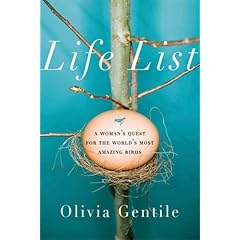
Olivia Gentile’s Life List is the book I gave this Christmas. My mom and my mother-in-law both got copies. I loved this book. I think about it all the time. I am a little amazed to find that it’s not a bigger phenomenon than it is.

Life List, the biography of legendary birder Phoebe Snetsinger was one of my favorite reads of fall 2009, but I had to special order it from Three Lives where they hadn’t heard of it. Though stumping the geniuses at Three Lives brings me a small swell of pride, I was baffled. How could you not want to read a book about a 50s housewife who turned a terminal cancer diagnosis into the inspiration to pursue her hobby of birdwatching with ever greater seriousness? 

And how not love the irony of her so far outliving her diagnosis that she eventually had the longest life list of anyone on Earth. Last year, when a friend sent me the information with a link to her friend’s (very fun, beautiful) website with tons of lovely drawings by Rebecca Layton, I was excited and filed the book away in memory. I happened to catch Leonard Lopate’s interview with Gentile on WNYC and my interest only grew.

Snetsinger’s story is a super-interesting manifestation of the Betty Friedan problem: she had always wanted to be a scientist but lacked the courage to defy social expectations; she married, had four children, and grew increasingly depressed and distanced from her marriage and life. The difference for her—the escape—was the combination of a terminal diagnosis and the financial security that came from having a successful husband and a small legacy from her father, advertising legend (Marlboro Man, Jolly Green Giant) Leo Burnett.

Gentile’s book is well written, mostly journalistic, but with a kind and humane voice and a strong feminist subtext—especially helpful in asking us to piece together and imagine some of Snetsinger’s choices and a real page-turner. In addition to being a really rich footnote on the plight of the dissatisfied housewife, Life List is also full of amazing story after story about exotic, dangerous, and uncomfortable birdwatching expeditions. I love the preface, in which Gentile goes on a bird walk as a disinterested beginner and the leader says “Who knows? You may be the next Phoebe Snetsinger!” That confident enthusiasm and the unusual name combine to make the germ of this wonderful book.

Monday, February 01, 2010

The Known World


I’ve been battling a cold and, today, though I felt better than yesterday, I took advantage of it’s being a school day (and my being on sabbatical) and just went back to bed.

Unthinkable!

I lay there and, in one swallow, finished the last hundred pages of Edward P. Jones’ masterpiece of a novel, The Known World.

Lately, I read about books, recommend them to my mother and my mother-in-law, and then heat up the orange mac for the kids while toiling away at some para-literary activity (marking papers, selecting essays for a textbook, downloading articles for an article I’m writing). My novel-reading days are too few and far between. If life in at 70 is as kind to me as it has been to my mom and mother-in-law, I may, perhaps, have a chance to catch up!

But my mom begged me to read The Known World so we could talk about it. I did. And I can’t wait to call her.

Wednesday, January 27, 2010

In Memory of Eric Rohmer


It would have been 1981 or 1982. I was in high school and babysitting on a weekend night for my cool yuppie neighbors. The parents came back all excited from their screening of “Claire’s Knee,” eager to tell me that I reminded them of Claire.

To this day, Puritan that I am, I cannot quite imagine myself into the position of a young girl who excites a middle-aged man’s lust. I was a bit freaked out by the comparison at the time. Did that mean that Mr. X…? But Mrs. X was giggling, too? It seemed too gross, too complicated to take in, so I avoided that film for years.

But, still, they were very cool. And I filed Eric Rohmer away as a director to watch. When I did, I fell in love.

More than any other film director, Rohmer is mine: I love his films and I love his women. I don’t know the Six Moral Tales as well as later films, so I was surprised to read in the Times obituary that his characteristic subject is “a man who is married or committed to a woman finds himself tempted to stray but is ultimately able to resist.” In that telling, he sounds like such a male director, but to me, his films have always seemed really friendly to women.

But then, the truth is, I identify with his heroines: nervous women, liable to talk to much, women who wear no make-up, and whose beauty varies tremendously from shot to shot—just as one’s own beauty does. Rohmer always lets you see that his actresses are beautiful. He lets them know it, too. But he also shows them doubting it in moments of stress or shows their beauty and confidence failing them just when they want it. Beauty is not everything, of course, but this is film—French film—and it’s so visual. And, for Rohmer, that raw, imperfect, eccentric beauty serves as a visual metaphor for worthiness—both to oneself and to others. It does not hurt that the women he directed are clearly very very smart: their beauty emanates from their intelligence.


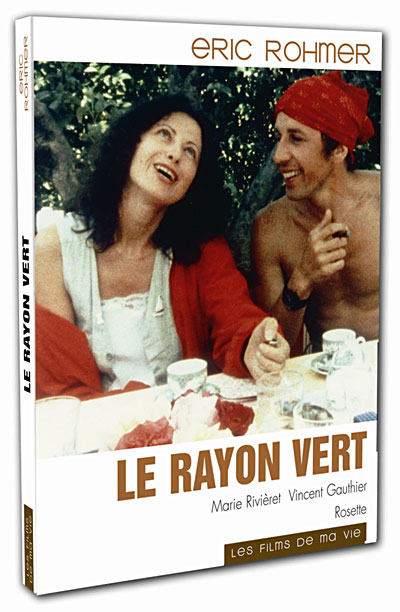
My favorite is “Le Rayon Vert” or “Summer.” It perfectly captures so many of my own vacationing dilemmas in my twenties and thirties. A young woman, newly single, must quickly make plans for a vacation during the national August holiday. She waffles from neediness—she’ll just go to the Alps and pop in on her ex—to friendliness—she’ll just be an easygoing add-on in a big family house—to bravery—she’ll go off to the shore alone. Alone on the shore, her bravery is intermittent. She is rude to cute men and kind to the wrong people. Her loneliness betrays her until she figures out how to be alone. It’s such a painful, uneven, crazily raw performance. It does so many things that an American mainstream chick flick just cannot approach: it allows you to see a young woman’s loneliness, including some of the humiliations of that loneliness, without humiliating her. It shows that loneliness as a mood--her boyfriend just dumped her, after all—not a condition.  I cannot get enough of it.

Last spring, Lauren hosted Jonathan Baumbach introducing “An Autumn Tale,” a late Rohmer film that shares a lot with “Summer.” I could take or leave the pretentious introduction, but the film itself was a glorious masterpiece: beautiful and interesting narrative, full of rich talk. It—and Rohmer himself—strikes for me, the perfect balance of intellectual filmmaking: still enough of a movie to be fun on a date, but provocative enough to inspire an essay.

Eric Rohmer died earlier this month at the age of 89. Marina Bradbury’s charming tribute includes this memory of her one visit to him a few years back:
"Excusez-moi," he said politely, and ducked into the next room, shuffling back moments later with a pile of coloured exercise books. He explained excitedly that the colour of each matched the palette of each particular film. For example, yellow in La Boulangère de Monceau (1962) reflects the colour of bread, whilst blue in Pauline à la Plage (1983) represents the sea.
And you can read A. O. Scott’s appraisal of his career here. What a wonderful legacy he has left behind.