Wednesday, January 27, 2010

In Memory of Eric Rohmer


It would have been 1981 or 1982. I was in high school and babysitting on a weekend night for my cool yuppie neighbors. The parents came back all excited from their screening of “Claire’s Knee,” eager to tell me that I reminded them of Claire.

To this day, Puritan that I am, I cannot quite imagine myself into the position of a young girl who excites a middle-aged man’s lust. I was a bit freaked out by the comparison at the time. Did that mean that Mr. X…? But Mrs. X was giggling, too? It seemed too gross, too complicated to take in, so I avoided that film for years.

But, still, they were very cool. And I filed Eric Rohmer away as a director to watch. When I did, I fell in love.

More than any other film director, Rohmer is mine: I love his films and I love his women. I don’t know the Six Moral Tales as well as later films, so I was surprised to read in the Times obituary that his characteristic subject is “a man who is married or committed to a woman finds himself tempted to stray but is ultimately able to resist.” In that telling, he sounds like such a male director, but to me, his films have always seemed really friendly to women.

But then, the truth is, I identify with his heroines: nervous women, liable to talk to much, women who wear no make-up, and whose beauty varies tremendously from shot to shot—just as one’s own beauty does. Rohmer always lets you see that his actresses are beautiful. He lets them know it, too. But he also shows them doubting it in moments of stress or shows their beauty and confidence failing them just when they want it. Beauty is not everything, of course, but this is film—French film—and it’s so visual. And, for Rohmer, that raw, imperfect, eccentric beauty serves as a visual metaphor for worthiness—both to oneself and to others. It does not hurt that the women he directed are clearly very very smart: their beauty emanates from their intelligence.
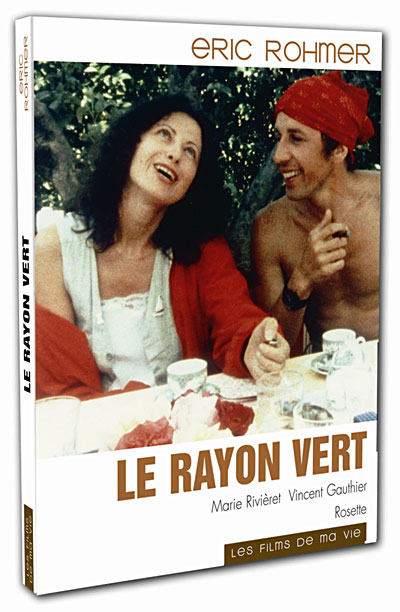

My favorite is “Le Rayon Vert” or “Summer.” It perfectly captures so many of my own vacationing dilemmas in my twenties and thirties. A young woman, newly single, must quickly make plans for a vacation during the national August holiday. She waffles from neediness—she’ll just go to the Alps and pop in on her ex—to friendliness—she’ll just be an easygoing add-on in a big family house—to bravery—she’ll go off to the shore alone. Alone on the shore, her bravery is intermittent. She is rude to cute men and kind to the wrong people. Her loneliness betrays her until she figures out how to be alone. It’s such a painful, uneven, crazily raw performance. It does so many things that an American mainstream chick flick just cannot approach: it allows you to see a young woman’s loneliness, including some of the humiliations of that loneliness, without humiliating her. It shows that loneliness as a mood--her boyfriend just dumped her, after all—not a condition.  I cannot get enough of it.

Last spring, Lauren hosted Jonathan Baumbach introducing “An Autumn Tale,” a late Rohmer film that shares a lot with “Summer.” I could take or leave the pretentious introduction, but the film itself was a glorious masterpiece: beautiful and interesting narrative, full of rich talk. It—and Rohmer himself—strikes for me, the perfect balance of intellectual filmmaking: still enough of a movie to be fun on a date, but provocative enough to inspire an essay.

Eric Rohmer died earlier this month at the age of 89. Marina Bradbury’s charming tribute includes this memory of her one visit to him a few years back:
"Excusez-moi," he said politely, and ducked into the next room, shuffling back moments later with a pile of coloured exercise books. He explained excitedly that the colour of each matched the palette of each particular film. For example, yellow in La Boulangère de Monceau (1962) reflects the colour of bread, whilst blue in Pauline à la Plage (1983) represents the sea.
And you can read A. O. Scott’s appraisal of his career here. What a wonderful legacy he has left behind.

Tuesday, January 26, 2010

Celebrating Woolf


If you’re in New York and in search of a Woolfian adventure, during this, her birthday week, you might check out a new play, Among Roses and The Ash.

I know nothing but nothing about it except the information they sent me, which I pass on to you here:
Among Roses and The Ash
Written by Elisabeth Aroneau and Kellie Mecleary
Directed by Kellie Mecleary
January 27-30, 8pm, January 31, 2pm and 8pm.
Tickets $10 at door, or online at fabnyc.org 
Purchase tickets in advance - seating is limited!
SYNOPSIS: AMONG ROSES AND THE ASH is a meditation on the power, beauty, and limitations of the English language, seen through the eyes of an author. Inspired by the life and work of Virginia Woolf, AMONG ROSES AND THE ASH incorporates movement, sound and image to explore the work of a literary artist. 
The Author contemplates two of her characters: a Woman planning a party, remembering past loves and questioning current ones, and a Man, haunted by his own past, attempting to create the world anew. As the Author travels through the lives and minds of her characters, she asks questions all writers must consider: what can one communicate through words? What gets lost and unexpectedly found? AMONG ROSES AND THE ASH is a lyrical exploration of our human desire to connect and all that may happen in the attempt.
WOW Cafe Theater is located at 59-61 East 4th Street 
on the Fourth Floor. 
between Bowery and 2nd Avenue in the Lower East Side of Manhattan, New York City, USA.


Sunday, January 24, 2010

1882 & then again, more recently


January 25th is the anniversary of the birth of Adeline Virginia Stephen, the third child of Leslie and Julia Duckworth Stephen, and the seventh child in their large extended family. Born in 1882, she grew up and became the novelist Virginia Woolf whose works make up the warp and weft of my mind.

It is also the birthday of my mom. Woolf says “we think back through our mothers if we are women.”

But she lost her mother when she was 13: she had to strive to think back through her. I get to talk to mine three or four times a week even now, into middle age. My mother still lives and thrives, to chaff me about my unkempt hair, to share books and stories with, to advise me, to send me unexpected presents. I am so blessed to have her.

If ever a coincidence were to send a doubting Libra to the astrology books, this January 25th Aquarian coincidence is it.

Happy Birthday!

Tuesday, January 19, 2010

Mishna Wolff’s I’m Down


Ooh! Dang, she just capped on you!
Ooh! Cap!
Man, that was cappish!

There was no surer way to irritate my parents in high school than a few slang words. Dog, doggish, cap, and cappish were prime offenders; mention them during dinner and you could see my parents squirm. It brought me great joy to demonstrate, on a nightly basis, to my parents, how very uncool, how very white, they were. This, of course, was not news to them.

I never was good at capping, but it was a big part of my life, especially in high school.

Out of the blue, my sister sent me a copy of Mishna Wolff’s very funny new memoir of growing up in Seattle, I’m Down. I read it with great pleasure in about a minute. It’s about a white girl who, among other things, learned how to cap.

It’s not really like reading a book—it’s so slight and fun and lively—but it is a really fun and interesting memoir about race in America, one that reminds us that behind the big narratives of race are a million idiosyncratic stories and that some of them, like Wolff’s, are touching and very funny.


The gap between the glamorous brunette in the author photo and the gangly, awkward teen with the biggest Afro I’ve ever seen on a white person signals the journey Wolff made, from her father’s house to the New York she lives in now. When Wolff’s parents divorced, she and her sister remained with their dad (in the house he’d grown up in), a man who, in her telling, really thought of himself as black (all evidence to the contrary). The neighborhood was now almost entirely black, as were his girlfriends and the guy friends with whom he played hoop and dominoes and to whom he sold dope. While Mishna’s little sister embraced her surroundings, accepting her father’s half-baked home remodeling projects, happily joining informal dance troupes and dressing up, Mishna was nerdy and nervous, worrying about grades, and struggling with her parents’ divorce and her father’s happy embrace of neighborhood life.

Eventually, her mother gets her enrolled in the IPP program (a souped-up honors program that Seattle Public Schools started after I graduated) and Mishna has to bridge the divide between the unhappy affluent children of divorce (no skiing this weekend! Mommy’s depressed!) and the mouthy poor children of divorce (hang on to your step-brother, the back door of the van opens when we hit a pothole). I particularly loved a poignant scene where Mishna, the absolute worst player on her amazing basketball team, runs into a white friend from school. Neither girl knows quite what to do, but Mishna snubs her school friend, with her upper-middle class "it's just a game" attitude and actually tries to score. It's not a kind choice, but it's the right one and it feels true to the conflicting loyalties of adolescence.

In more serious hands, this wouldn’t be as funny a book. There is a lot under the surface that I would like to know more about: How serious was that pot farm in the basement? What happened to the little black girl with glasses, the other smart nerdy kid in Mishna’s neighborhood? As a Seattleite, I wished for neighborhoods—it seems like this was Rainier Valley-ish, somewhere south of the Central District where I went to high school—but I was always wanting to know the name of the high school, the street. As a writer, I wanted to hear more about class, happiness, ambitions, and low expectations. Somewhere in this book is an insight about race and class privilege. Moving between worlds as she did, Wolff saw how easy it is for the affluent white daughter of an alcoholic mother to make it, debt-free to the liberal arts college of her choice where she will, of course, be free to mess up her own life or not. At the same time, the poor black daughter (or the black-identified white daughter) of a pothead will have to claw her way to that same spot. There are no middle class black people in this book, though one of her father’s girlfriends is nearly middle class—and a source of great (if temporary) hope for Mishna.

In all, this is a really wonderful light read about an ordinarily heavy topic. And besides, she gives a shout-out to Ezell’s Fried Chicken! Right across the street from my beloved Garfield High.

A review here. A clip of her reading about capping here. Her very funny website here.


Monday, January 18, 2010

Happy Birthday, Dr. King

In honor of the Martin Luther King Holiday, I wanted to remind you of Charles Johnson’s wonderful short story, “Dr. King’s Refrigerator,” from the collection of the same name. Here’s how Z. Z. Packer summarized it in her 2005 review of the collection:
In this story King stays up working on an overdue sermon, and when he looks into the refrigerator for a late-night snack he finds ''bright yellow slices of pineapple from Hawaii, truffles from England . . . a half-eaten Mexican tortilla . . . German sauerkraut and schnitzel right beside Tibetan rice . . . macaroni, spaghetti and ravioli favored by Italians.'' Struck by how something as basic and elemental as food can represent the interconnectivity of life, King basks in this revelation only to be brought to earth by his loving wife.
My husband and I had the privilege of hearing Johnson read this story at a conference in Seattle a few years back. It was fantastic.


Enjoy the day and honor the legacy of Dr. King.

Friday, January 15, 2010

Two Contests: Fiction & Nonfiction

Michelle Herman (whose memoir in essays, The Middle of Everything, I really admired) writes that there is a new deadline—January 31--for The Journal’s nonfiction prize. Here is the info:
Please, if you write nonfiction, send us something! New deadline: January 31, 2010.
Annual William Allen Creative Nonfiction Prize
(A competition that honors William Allen, the founding editor of The Journal)
$500 and publication of the winning essay in The JournalAll styles, subject matter, forms welcome. New deadline for postmark of mss is January 31. All mss will be considered for publication. An entry fee of $10 should accompany each manuscript (make checks payable to The Journal). Max word count is 6500 words. Include an SASE.
Send submission & entry fee to:   

Nonfiction Prize
The Journal 
Department of English
The Ohio State University
164 West 17th Avenue
Columbus, Ohio 43210

Alison Weaver, of H.O.W. Journal (of which I’m on the board), writes of their fiction contest (that deadline is a generously distant May 15)—judged by Susan Minot.


H.O.W. Journal is hosting its first short story contest to be judged by acclaimed author Susan Minot.Guidelines:
The contest is open to all writers and all themes. The word limit is 12,000. We do consider unpublished novel excerpts if they feel like complete stories. It's fine to submit more than one story. Manuscripts should be submitted with a cover note listing the author's name, address, phone number, and email; names should not appear on the stories themselves. All submissions should be clearly typed manuscripts, double-spaced on 8 1/2 x 11 inch white paper, one side only. Submissions will not be returned. No simultaneous or previously published work.
Awards:

  • 1st Place - $1000 and publication in H.O.W. Journal
  • 2nd Place - $300 and publication in H.O.W. Journal
  • 3rd Place - $100 and publication in H.O.W. Journal


Reading Fee per story: $20.00
Send your submissions and reading fee (a check payable to H.O.W. Journal) to:
H.O.W. Journal
 -- Short Story Contest
12 Desbrosses Street

New York, NY, 10013 
Submissions must be received in the H.O.W. offices by May 15th, 2010. We look forward to reading your stories!
Both have entry fees ($10 & $20, respectively), so submit with care. But sometimes a contest is just the motivator one needs. Good luck!

Thursday, January 14, 2010

Nina Paley’s Sita!


Taking my mom’s advice and giving myself a day to enjoy some time to myself last Friday, I went to see Nina Paley’s animated film, “Sita Sings the Blues” on the strength of A. O. Scott’s enthusiastic review in the Times. (There's an earlier positive review here.)


It’s such a treat. Just look at the art!

The movie parallels Nina Paley’s own failed marriage, precipitated by her (now ex-) husband’s move to India for a job, with the miserable and humiliating plight of Sita, the wife of Ram, as detailed in the Ramayana.

There is so much to love here: the art is exuberant and funny and the improbable (and slightly wacky) parallel works because it’s not forced, because it’s treated with wry feminist humor, and because the varied drawing styles and vivid, smart writing (especially the chorus of three Indonesian shadow puppets who appear from time to time to bicker over their imperfect memories of the story of Sita) keeps it lively.

We mostly follow poor Sita, who follows Ram into exile in a dangerous forest where she is kidnapped. When Ram finally rescues her, he forces her to undergo a purity test (by fire), which she passes. Still doubting, he exiles the pregnant Sita a second time. She raises his children in the forest, teaching them to love Ram. These episodes of the epic humiliation of a faithful wife are intercut by the minor key and excruciating scenes of a drably drawn Nina being scolded by Dave when she arrives in India. Her exuberant hug and kiss is met with a cold: “Don’t kiss me in public! This is India!”


I have dated that guy. It stinks.

I didn’t know till afterwards that the film's distribution had been held up because, in using 20s recordings of blues singer Annette Hanshaw (whose songs are a highlight, coming out of a Betty-Boop style Sita’s mouth), she ended up owing about $50,000 in rights to others. (Don't get me started on how unfair copyright is to artists and scholars!) All the copyright nightmares—now resolved—are detailed here. They mean, happily for you, that you can watch Sita for free online! Or buy the DVD. Do it. There are so few great films by women and Nina Paley did EVERY BIT of this by herself. It's amazing.

It’s a great movie!

Wednesday, January 13, 2010

Forgetting Haiti

''Life is already so fragile in Haiti, and to have this on such a massive scale, it's unimaginable how the country will be able to recover from this.''--Edwige Danticat (via Tayari)

It’s easy to forget about Haiti, the poorest nation in the Western Hemisphere. Haiti is so hard to think about—even before this latest castatrophe—that, unless there is a hurricane or a new novel by Danticat, it’s easier to focus elsewhere.

Eight years ago this month, I spent three weeks on a service-learning trip to the Dominican Republic. We had been scheduled to go to Haiti, but the events of 9/11/01 worldwide and a coup d’etat in Haiti led my university at the time to prudently shift the trip to the more stable DR, the Eastern and more prosperous half of the island of Hispaniola.

It was one of the hardest times of my life: my husband and I read and studied Michele Wucker’s amazing book about the island, Why the Cock Fights; we read Edwidge Danticat’s stories of Haiti and Haitian-Americans, we read In the Time of Butterflies. We longed to lead our students on a trip about social justice. Instead, we worked with an orphanage in Monte Cristi, on the Haitian border, to build a wall. 

That wall became a metaphor for the barrier between the kind of aid work I believe in and the corrupt, self-congratulatory, neo-imperialist mission excursion that I found myself on, but not able to lead.

For all that was hard, I must admit that I was not sorry that we didn’t go to Haiti. My husband’s scouting trip to Haiti, in the summer of 2001 (before plans changed) had been intense and life-changing for him, but his stories of the rural mission in Northern Haiti that would host us, of the drums at night, of the village that was little more than a collection of shanties, made me painfully aware of how ill-equipped I am to comprehend the gap between the poorest in the world and myself. 

In 1804, Haiti became a free nation. The second democracy in the Western Hemisphere. In the two centuries since, it has failed—and we have failed it. I don’t want to make a catastrophe—or a nation—into a metaphor. I hope and pray for better days for Haiti. I texted “Yele” to 501501 twice this morning, sending my $5 two times to Wyclef Jean’s nonprofit. But when I see the Haitian Ambassador to the U.S. on television last night, mainly concerned with reassuring us that the first lady is fine, I boil with outrage at the intractability of a problem—theirs and ours—that I do not begin to know how to think about solving.

My college friend, the brilliant Annie Seaton (now a Dean at Bard College) suggests that this catastrophe—the earthquake and all the things (poverty, deforestation, buildings without re-bar in the concrete, political instability, racism) that make this earthquake so horrifying—is a result of the Enlightenment. I think that maybe she’s right. Maybe, as she suggests, we should all read Susan Buck-Morss on Hegel and Haiti and, while we pray for the victims, the survivors and all who help them, we should also try to think our way to a more just world, one in which Haiti would not always and forever suffer.


L’Esprit du Salle de Bain


I don’t really suffer from l’esprit du l’escalier: I’m not witty enough, don’t go out enough, to find myself agonizing over the devastatingly apt bon mot I should have uttered.

My problem comes not at the end of a social evening but in the transition from the morning shower to the day. In my shower, I imagine the clever blog posts I’ll compose, the quickly dashed off letter of recommendation, the lyrically satirical short story, the thoughtful and surprising essay. Then, I get upstairs, clean but hair uncombed (I really do hate to brush my fine, tangly hair, so I postpone as long as possible), check facebook and call it good enough. It's l'esprit du salle de bain: a momentary feeling of great creative power that, confronted with the fact of a sink full of dirty glassware and a living room strewn with dollies, dissipates as quickly as the steam on the bathroom mirror.

When I was in high school, one of my parents said to me “Anne, your [father? Mother?] and I think that you’re basically lazy.” They don’t remember it and I think that’s because it was said only once, in a very specific situation, in response to a moment of underachieving from me. Teenagers are exasperating and I was a teenager at the time. They certainly never treated me like a lazy person. But oh, how my superego feasts on this phrase, wandering between the prick of ambition and the siren song of procrastination.

Friday, January 08, 2010

Bridget Jones Redux


The problem of how to spend, mark, and assess the worth of my research leave has been bugging me. It’s a high-class problem, believe me, I know. Still… My husband is reading Murakami’s running book, which, I read, got its start as a training journal. This and my own goals have got me thinking, mostly jokingly, about writing an amped up version of those tired year-in-the-life memoirs: how many pages written and read, how many minutes of what kind of exercise, how many WeightWatchers points consumed, how many pounds lost and gained. It’s a 9-month leave, if you include summer, and maybe I could just keep track of my progress and setbacks.

All of this, however, seems too depressing and too far from the real goals of having fun in the gym while losing weight, and, more to the point, of contemplation, reading, and writing something that makes a real contribution to a meaningful conversation.

It’s not that I’ve lost my sense of humor: heaven forbid! Just that I feel my energy draining away in the triviality of witty comments on friends’ status updates or bits of self-deprecation about my latest sampling of the children’s macaroni.

I was shocked recently when my mother, stern-voiced, told me that she hoped I would work very hard during my leave: “Why don’t you put in four good days each week,” she said, as if imposing a strict limit. All I could think was four? Only four? “and then do something nice for yourself on Fridays: go to a museum or a movie.” My girlfriends agreed with my mom.

Frankly, Fridays “off” hadn’t occurred to me. But it has now. I’ve been to the gym. I have a small task to do for my spouse, and then I’m heading to a matinee. See you on Monday.

Tuesday, January 05, 2010

Center for Fiction Conference SATURDAY

Make good on your New Year’s Resolution to write: come to the conference this Saturday at the Center for Fiction & get a month’s studio space!

We all need a room of our own to write in, but in New York, private space is tough. In our Jersey City apartment, I can write at the dining room table during school hours; in the evenings, when my husband isn’t working late, we’re often flipping: do you want the chilly but quiet downstairs bedroom or the spacious and distracting upstairs? My tiny closet of an office at school in midtown is subject to professional interruptions (for interruptions there will always be, as Woolf says) and has no windows. (Some of my colleagues have windows, but windows go by seniority. My best guess is that I’m about ten years out from a window.)

But, as you can hear, this blog post is really a pitch for you to consider coming along Saturday to the Center for Fiction Conference. The $170 fee entitles you to listen to a day’s worth of stimulating talk about the business and professional side of fiction writing AND a free month of studio space at the Center for Fiction.

I’ll be moderating a panel in the morning (10:45) on finding and creating community. On the panel will be Ken Chen of the Asian American Writers’ Workshop, Amanda Stern of Happy Endings, and Kamy Wicoff of SheWrites: three exciting writers each of whom has added to the community of writers in which we live. I am so looking forward to hearing what each has to say about how we as writers find the balance between sitting alone with our words and reaching out to others.

Other speakers are as luminous as my panelists: The day begins with a keynote by Daniel Menaker; Ron Hogan is organizing the whole thing and moderating a panel on publishing today; if you don’t want to listen to our panel, you can hear Liesl Schillinger moderate a panel on the importance of book reviews; Lauren Cerand will be on a panel about creating your own buzz (she should know!); Marlon James, Peter Ginna, and many more will be speaking. It sounds like fun to me! I hope to see you there.

Research Leave

My research leave starts NOW. True, I have a bundle of loose ends to clear up from the semester, but it’s also true that this is my first post-tenure semester off. I had a junior leave at Purdue during which my father-in-law died and which I spent applying for jobs elsewhere; I had a junior leave at DePauw, which I also spent on the job market. Oh, the life of an academic married to an academic is not a simple one. But this time, I am not pregnant or grieving, and, touch wood, I hope to actually spend it on the projects at hand. To whit:

1. Finish the Cambridge edition of Mrs. Dalloway.This is to be a textual edition, which means I am comparing every single edition of the 1925 novel published in Woolf’s lifetime (1925-1941) in English. There are some minor but significant differences among these editions, especially between America and England. A large and dull part of this job, then, is to compile a big list of variants. Then, too, I must find, write and compile all the footnotes necessary for understanding the novel. Now, it’s true that you can get a nicely footnoted edition from Harcourt or, if you were lucky enough, you got a British Penguin or OUP edition during those brief halcyon days in the early 90s when Woolf was out of copyright in the UK. (She went back in under the stricter EU rules when England joined the EU.) But the Cambridge brief is different: each of us is to footnote everything a scholar could need. This means that some things a common reader might want may not get footnoted while many, many other things only of interest to specialists will. Finally, I have to write a long introduction offering a textual history of the novel. I’ve been hacking away at this project for the lifetime of my second child and now that she is approaching four, I finally have time from teaching to dedicate to it.

2. Lose 25 pounds. Self-explanatory and much harder than #1. Wish me luck.

Thursday, December 03, 2009

Girls Write Now

If you read litblogs, you’ll have heard of Girls Write Now. Lauren Cerand is the Board Chair. Tayari Jones and Maud Newton are on the board. So am I. Truly, it is humbling and thrilling to be in the company of such inspiring women. But it’s the girls who inspire us all.

If you don’t know about Girls Write Now—this brilliant non-profit that pairs NYC high school girls with women writers—or if you haven’t yet given them a little Christmas/Hanukah/Eid/year-end donation, now is the moment for this amazing little non-profit is trying to raise $50,000 this holiday season, to keep their programs running and to expand them to serve more girls in need.

You can click right here and make an express donation through the Network for good.

At Girls Write Now's Holiday Soiree last month, I spent a festive evening with many of you at the Center for Fiction, where we each reached out to friends and family, writing letters for the Annual Holiday Appeal. I took this time because I believe, to my core, that helping girls write will change the world. Those letters have elicited a warm response, and to date we've raised $18,706. I wrote 34 letters that night to friends (and won the prize for the most letters written!); so far those letters have brought $625 to Girls Write Now. Every little bit counts.

Girls Write Now is on the rise. You may have heard that on November 4, Brooklyn high school senior Tina Gao joined founder and executive director Maya Nussbaum in accepting the 2009 Coming Up Taller Award from the President's Committee on the Arts and the Humanities, distinguishing Girls Write Now as one of the top 15 after-school arts and humanities-based programs in the country.

I came to my first Girls Write Now event to hear Tayari Jones and Janice Erlbaum read from their work; I stayed--and went on to join the Advisory Board--for the girls. As a Virginia Woolf Scholar, I guessed that other Woolfians and feminists might respond to the power of the mission, too, so last spring I made Girls Write Now the beneficiary of our silent auction. So moved were the 200+ attendees that we were able to raise more than $2,000.

When people hear about Girls Write Now, they give to Girls Write Now. It's as simple as that. Won't you please consider giving and help me spread the word?

Saturday, November 21, 2009

H.O.W. Holiday Costume Party!!!

I'm on the board for the H.O.W. Literary Journal, an exciting new journal that is also a charity dedicated to helping orphans worldwide.

On December 6, they're having a holiday party with readings by Willie Perdomo and Tao Lin and the proceeds benefit teens in the Safe Space Program.

My costume involves peacock feathers.

Tickets are only $20 and drinks are free from 6-7. Click on the link to purchase.

What's not to like?

H.O.W. Journal wants to see you
on Sunday, Dec 6th, 6pm - 9pm

at Macao Trading Co.
311 Church Street, NYC 10013
$15 advance tickets, $20 at the door
Funds raised at this event will be used to start an art, music and film-making program for young adults at Safe Space. For more info. and to buy tickets please see below.

Readings by Tao Lin and Willie Perdomo

Free Drinks from 6-7pm!

Holiday Costume Contest

Thursday, November 19, 2009

Where I've been, etc...

It seems like I'm gone, but I'm not.

I will be back.

See, usually my blog is a welcome dose of sanity during a busy semester. This semester is no less busy, but approaching I see the heartening sight of January and with January comes A SABBATICAL.

So, I am simultaneously very very busy and looking forward to regrouping with you all when I really have a moment to compose myself.

Until then, I will be grading papers.

Monday, October 12, 2009

Jessa Crispin likes Sarah Hall, too

From the NPR book blog: a strongly positive review of How to Paint a Dead Man by Jessa Crispin.

I'm still surprised that more people in the Hall roundtable didn't love it as much as I did.

Monday, October 05, 2009

Best Essays, a request

In earlier days of blogging, people used to publish requests for info all the time. (I am trying to avoid the ugly coinage "bleg.") Now, I guess, that's what Twitter is for. But I am going old school today to ask you to tell me your favorite essay or two these days.

I'm nominating essays for the new edition of the Norton Reader, a commonly used freshman writing textbook. (It's the one I use, too.) I'm doing my homework, rest assured, but I can't read everything and I would love to hear the essays that are thrilling you these days.

Here are some of the things I'm thinking about: Though I was a bit disappointed by Rebecca Walker's collection, I love Dan Savage's "DJ's Homeless Mommy." I liked the essays by ZZ Packer and loved Min Jin Lee's, but they speak from such a position of privilege that they really don't go in a freshman textbook, I don't think. Packer is mordantly funny about having consistently been mistaken for her son's nanny (he is--or was--much fairer than she, having a white father); but Packer is so quickly dismissive of the Midwest that I think she'd lose huge chunks of her audience on a throwaway line. Min Jin's essay is deeply moving but it's about her awkward attachment to her nanny, a woman who is, like Lee herself, an immigrant. I just think the social complexities of New York might not translate broadly.

I'm hoping to find something in Kenny Fries' book. I bought Dwayne Betts's memoir of his time in prison in the hopes that it would lend itself to excerpting; what I've read has been riveting. I have a lead on a great Solnit essay. Ander Monson has a couple great essays, so I'm having trouble choosing which to put forward.

In the end, I'll pick twelve and the editors will take, oh, one or two.

If my list doesn't jog your memory, maybe Maud's will. If you have a winner in mind, I'd love love love to hear about it!

Sunday, October 04, 2009

West Coast Hornby/McSweeney's Event!

A former student writes from her internship at 826 Valencia/McSweeney's to say that I should tell all my readers about this event: a special screening with Q&A by Nick Hornby of his new film. I think I should:
a special advance screening of
an education
a new film written and produced by nick hornby with an in-person Q&a with the author
wednesday, october 7, 2009 O 8:30 p.m.
$30 for tickets + a free book

The screening will be held at the Embarcadero Center Cinemas, Promenade Level, located at One Embarcadero Center in San Francisco.
purchase tickets online here:
Directions and theater information are here:
Further questions? Email letters@believermag.com or call (415) 642-5684
$30 is a lot, but when you throw in a book, it's a great deal. I don't really know if I have a lot of readers in San Francisco, but if I do, here's a great-sounding fun event for next week.

Sunday, September 27, 2009

The Clintons at the Minetta Tavern

My dad and I were utterly charmed by Frank Bruni’s review of the new Minetta Tavern. So charmed that we had the same idea: this would be the perfect spot for our Saturday night dinner in September, my birthday dinner. My parents still live in Seattle, where I grew up, so these twice-yearly visits of theirs to New York City are much anticipated on all sides. They revolve around eating and we have made it our custom to get a babysitter on Saturday and go out someplace really fancy. The Minetta Tavern would be a bit of a break from tradition--it’s a steak house in the West Village—but Bruni made it sound so fun and fabulous that it seemed worth it.

When the only reservation we could get was for 6:00, we hesitated: do we really want to settle for such an unfashionable time? After all, the city has many, many other grand restaurants. My dad and I held fast and, since this was for my birthday, I held the day.

That block of MacDougal Street is still caught in the 80s: falafel shops and beer dives, tourists eating lousy looking nachos, thinking they’re experiencing the West Village. My husband and I walked around the block to see Il Mulino, where Presidents Clinton and Obama had lunched a few weeks back. That was exciting and funny, too: on the one hand, Il Mulino is tucked away. On the other hand, it’s across the street from NYU law. Not hard for them to find, we thought. The Minetta Tavern inside leaves the falafel far behind; it is full of old world charm: just as lovely and hip as Frank Bruni promised.

We walked in at 6:00 and couldn’t be seated right away. It was packed and the energy was young and vibrant. Passing from the bar to the dining room, I overheard one waiter/manager say to another: “San Francisco chef and restaurant owner; position three.” It seemed we were in a happening spot. Little did we know. When our waitress came to take our order, the hostess and maitre d’ were opening and shutting the side door; we could see red flashing lights; our waitress was distracted.

Five minutes later, we could see why: Hillary Clinton came in with two aides.

That was exciting, but it was even more amazing when, a few minutes after that, Chelsea and her boyfriend arrived.

When, ten minutes after that we heard a familiar voice say “Sorry I’m late,” as the Big Dog himself sidled into the booth.

It was very, very exciting! And distracting. And fun. Hillary Clinton looked beautiful—really happy and rested and lovely in a pretty ivory jacket with boucle details on the lapels. Chelsea is very, very pretty, too, in a black sleeveless tank and a gorgeous necklace of gold loops.

It was hard not to gawk or ask for an autograph. We did keep track of their orders—beet salads for the Clintons to start, burger for Chelsea and fish for Bill at dinner. Not a lot of wine at all. (The four of us, on the other hand cruised through a bottle of champagne and 2 reds.) I wanted to meet Hillary Clinton especially, but once it was a family dinner any intrusion seemed cruel and wrong. We giggled that I should start mentioning my days at Wellesley and Yale really loudly, but, in the end, we let them eat in peace. So did everyone else.

That is, until Rob Reiner came in with his family. (I know!!!) Meathead, as I still love to call him, greeted the Clintons and President Clinton greeted the Reiner family while Reiner talked with Hillary.

(Turns out, there was a tiny little Streisand concert at the Village Vanguard last night…)

It is very strange to think of the Clintons as people, to see that they are real. Hillary’s charisma was palpable from the moment she entered: she was powerful, kind, beautiful, and self-posessed. Bill, in tattersall and a blue blazer, was more like charisma in retirement: stunning, but in repose. I have been thinking, this fall, that maybe I’m becoming a New Yorker (with a Jersey zip code) but this knocked me right back. I was utterly star-struck.

Wednesday, September 23, 2009

Still Three: Big Yesterday

This is perhaps my favorite coinage yet: big yesterday for a while ago.

In the car
3 y.o.: Mommy, mommy, yesterday, big yesterday we went there [McDonald’s] with Miss Jackie [the babysitter].
Mom: Oh, that’s nice, honey.
6 y.o. [aggrieved, righteous]: We did not go there yesterday. Miss Jackie didn’t even come yesterday. She took us there a long time ago.
3 y.o. [also aggrieved, righteous]: Yeah, I said big yesterday.