Wednesday, July 14, 2010

All Paris, all the time

“Marie had had it with the City of Lights. The fucking Eiffel Tower. Overpriced baguette sandwiches. Benoît Doniel.”—Marcy Dermansky, Bad Marie

Happy Bastille Day.


It’s a Paris summer here at Fernham. I sit in this hot little rented house, staring out at the hazy St. Lawrence River, thinking and reading about Paris.

In Bad Marie, Marie runs off to Paris, which plays a comic version of the role it plays for James and so many others. At one point, Marie thinks “Everyone was always speaking French. Marie found it maddening.” Later, in a yet darker mood, “The city was impressively landscaped, if nothing else.” At a café, Marie thinks “The beer was cold, good, better than any other beer she had ever drunk before….Caitlin was also happy with her milk, which supposedly was also better. Europe was supposedly a superior continent in so many ways.”

This book was all the funnier coming on the heels of The Ambassadors, where Jamesian versions of these thoughts abound on the lips of the visitors from Woollett.

It’s strange, then, that James asserts in the preface that “Another surrounding scene would have done as well.” And this is the very question that Erika Dreifus takes up in her essay on The Ambassadors, which she was kind enough to send me. There (in The Henry James Review, 25 (2004): 44-51), she writes about setting and the centrality of Paris to the novel from the perspective of a historian, teacher, and fiction writer. 

Another scene would not, could not, do as well—for Marie’s getaway, for Strether’s awakening, for James Baldwin or Richard Wright or F. Scott Fitzgerald or James Joyce or Gertrude Stein.

Or Sylvia Beach.

Which brings me to remind you that I’ll be giving over Fernham for a full week to Sylvia Beach, the proprietor of Shakespeare & Co. and the first publisher of Ulysses. This is in honor of Keri Walsh’s brand new edition of Beach’s letters.

I looked around to see if others were reading and blogging about The Ambassadors and I found two more things of note:

A blogger called Bruce Oksol has a lovely post of his first impressions, including these:
7. Henry James writing style is perfect for learning to diagram sentences (which I doubt anyone does any more). His sentences are very, very long. Likewise, his passages are very long. James can take two pages to say that two people look alike.
8. I have found at least one occasion in which James uses a word that doesn't exist in the English language, but looks like it should. In context, one can almost figure out what James was saying but who knows for sure. 
 and this:
I am 58 years old. The protagonist in The Ambassadors is 55 years old. He and I are asking the same questions.

And The Millions informs me that Cynthia Ozick’s forthcoming novel, Foreign Bodies is a retelling of The Ambassadors. The Times describes it this way:
Cynthia Ozick will return to the subject of families in need of reconciliation in a new novel called “Foreign Bodies.” On Wednesday, Houghton Mifflin Harcourt said it had acquired the book and planned to release it in winter 2011. In a statement, the publisher said the new work, set in postwar New York, Paris and California, “is the story of a divorced schoolteacher who tries to resolve her brother’s family dramas, leading to extraordinary and wholly unanticipated results.”
That seems better than the nonsensical publisher’s blurb that “the plot is the same, [but] the meaning is reversed.”

How can you “reverse” the meaning of a James novel? As E. M. Forster wrote, “it is Paris that gleams at the center…--Paris—nothing so crude as good or evil” (via Erika’s article). What is the opposite of Paris?

Don’t answer that. I think I’ve lived there, too.


Bad Marie in the Times

A lovely article and an adorable picture of Marcy and her daughter Nina in the New York Times today!

Tuesday, July 13, 2010

Bad Marie


A few years ago, I met Marcy Dermansky at Housing Works and she gave me Cate Blanchett’s copy of her novel Twins.

That is, Marcy had been on her way to a screening and had thought that, perhaps, if she got near enough to Cate Blanchett, she would give her a copy of her book. But, she didn’t get near enough and she met me instead. So my unprepossessing paperback copy bears the distinction of have been intended, albeit somewhat haphazardly, for a movie star. We have since become friends, trading stories of our daughters and going swimming on facebook, so it didn’t take much begging to get her to send along an advance copy of Bad Marie.

There are movie stars in Bad Marie, too. And, like Twins, this is an utterly delightful gobble of a book. I am not a fast reader, but I did gulp this up in a day.

It’s a wonderfully silly book—you have to just go with its utterly improbably donnée: that Marie fell in love with a French novel about sea lions in prison, that her girlhood rival has married the novelist, and that, upon her release from prison, Marie insinuates herself into their lives as the babysitter. Once you’ve gone that far, then following Marie as she hops onto a jet to Paris with the husband and toddler in tow is nothing—and such great fun. I am all in favor of farce, and this book delivers. There is something very La Cage Aux Folles about the whole thing: like one of those crazy French bedroom farce films from the 70s and 80s.

I remember dragging a boy to see Jupiter’s Thigh in 1982, a movie in which adulterous French archeologists jumped in and out of bed with each other on a race to find out what statue a fragment belonged to. All along, it was thought to be the femur of a small statue of Jupiter but, in the movie’s final shot it’s revealed that, all along, it’s been the penis of a larger statue. Dumb, but unforgettable, and kind of worth it. ­Bad Marie is better than that—it’s anything but dumb—but it offers the same kind of wild, reckless pleasure.

I love the first line: “Sometimes, Marie got a little drunk at work.”

I like this scene, a confrontation between Marie and her employer/rival. They are at a restaurant and Marie has just been given notice: “They still hadn’t touched their shrimp rolls. She stared at the fresh plates of steaming hot food, almost helpless before it. She would be unable to make a heroic gesture. She would have to eat everything, drink her beer, order another. She would let Ellen pay for her meal.”

I like Marie’s comparison to life on the run with her bank robber boyfriend and this version of it, toddler in tow: “Marie was stunned by the déjà vu. The leaving fast, the ridiculous thrill of leaving everything behind. This time it was slightly more complicated. Marie was traveling with juice cups and diapers, organic string cheese. A child. A stroller. This must be a sign that Marie must be growing up.”
           
Wonderful! The skewed perspective of a girl who thinks that her impulsive kidnapping is a step ahead of her impulsive running away years ago. As in Twins, Marcy does a great job of depicting reckless young women, failed by their parents in some fundamental way, trying to grow up, but also following every impulse. Her heroines are not timid girls, ambitious girls, or planners. They see a boy, like him, and take off their shirts. For a quiet girl like me, even reading such a book is a kind of revelation. Really? Do people just do that? I feel like Strether: Oh, it’s too late for me, but, goodness! the things I’ve seen really do show me something about how to live…


Monday, July 12, 2010

Baby sparrows


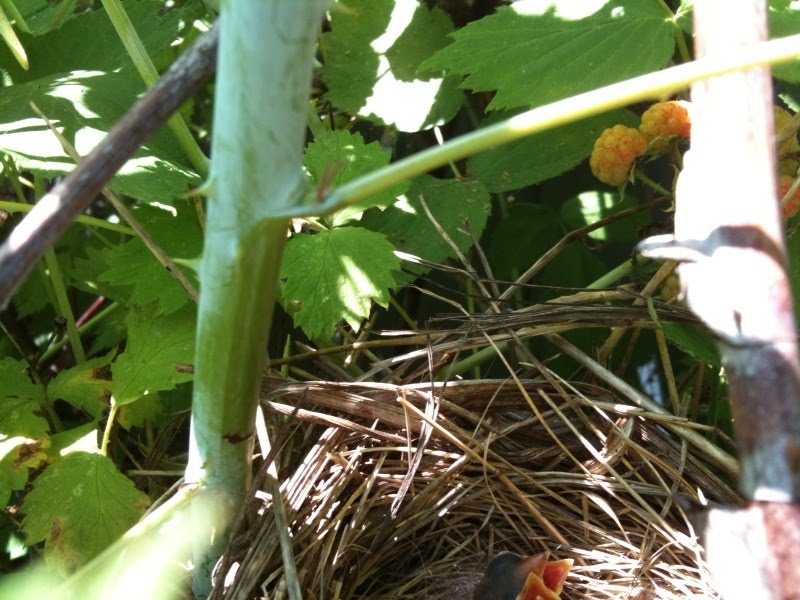
There is a black raspberry bush right outside the kitchen door of our summer rental, and was picking berries the other day. I pulled a branch aside only to find a nest full of baby birds.

I haven’t wanted to bother them, so I let myself take a picture every two days. We were away for the weekend and this morning, when I went to take a picture, I startled the birds and two tumbled out of the nest and hop-flew away. The mama—who revealed herself as a sparrow—flew down to protect the one on the sidewalk. The other fell into the bush. I hope they’ll be fine; I expect they will. I am glad that they’re big enough for me to pick berries again. They’re getting ripe.

I thought you might like to see the birds, too.

July 5, 2010.

July 7, 2010.

July 9, 2010.


Friday, July 09, 2010

Watch this space for MORE PARIS!

Just the tiniest of posts to say that Keri Walsh and I are planning a whole week of Sylvia Beach posts for you, come July 18th or so, so get your copy of the letters and dream of Shakespeare and Company....

Thursday, July 08, 2010

What kind of a Review is it?

I have finished James' The Ambassadors and am taking notes and basking in its excellencies. Here is my beloved Lambert Strether, describing how he bides his time in Woollett, Mass., and the extent to which he keeps away from the business which makes Mrs. Newsome and her son Chad so very, very rich. His friend Maria asks if he is involved in the business itself:
‘Oh no, I don’t touch the business.’
‘Only everything else?’
‘Well, yes—some things.’
‘As for instance--?’
Strether obligingly thought. ‘Well, the Review.’
‘The Review?—you have a Review?’
‘Certainly Woollett has a Review—which Mrs. Newsome, for the most part, magnificently pays for and which I, not at all magnificently, edit. My name’s on the cover,’ Strether pursued, ‘and I’m really rather disappointed and hurt that you seem never to have heard of it.’
She neglected for a moment this grievance. ‘And what kind of a Review is it?’
His serenity was now completely restored. ‘Well, it’s green.’
‘Do you mean in political colour as they say here—in thought?’
‘No; I mean the cover’s green—of the most lovely shade.’ 
My favorite is how his "serenity" is "restored" when he can return to the solid ground of describing how pretty his little magazine is. 

Wednesday, July 07, 2010

How I love Mark Bittman

My father always says that there is nothing that is not better with a little peanut butter. To prove it, he would, when we were little, accept our challenges to add peanut butter to everything from vegetables to burgers. He was always right: peanut butter makes life better. I used to sit on the counter next to him with a couple spoons, a jar of Adams Natural Extra Crunchy and a jar of Best Food’s Mayonnaise. Dig in! So this, from Mark Bittman’s grilling piece in the Times this week made me laugh out loud:
20. Grill pineapple (or anything, really, from pork to tofu to eggplant). Make a sauce of half-cup peanut butter, a tablespoon (or more) soy sauce, a dash (or more) sriracha chili sauce, a handful of basil or mint and enough warm water to thin. (I’m tempted to say, “Throw away the pineapple and eat the sauce,” but the combination is sensational.)
If you don’t have his Kitchen Express yet, it’s a great cookbook for anyone who already knows how to cook: full of easy and creative ideas for throwing dinner together in a snap, all along the lines of this Times grilling piece: healthy and hearty, big flavors, not too much work. It’s the only cookbook I brought with me to the River this summer and I’ve loved everything I’ve made so far.

P.S. So far includes:

  1. grilled shrimp & watermelon skewers
  2. chicken paillards, grilled radicchio and endive & grilled lemons
  3. sauteed zucchini and tomatoe with chorizo (or, if your market is really awful, spicy breakfast sausage...)
P.P.S. In spite of the heat, the abundant vegetables, and my devoted adherence to 5 days/week of exercise, I have lost no weight. Hmm... 

Tuesday, July 06, 2010

Sissinghurst


I am still occasionally reluctant to admit I’m a Woolf scholar, but I’ve never been a Bloomsbury person. I drew the line there.

Nonetheless, I loved my visit to Sissinghurst Castle and Gardens, a ruined castle which Vita Sackville-West and Harold Nicolson made into one of the most celebrated gardens in England. What makes Sissinghurst special is that it represents the best of an English garden: lush, overplanted, and making subtle use of architectural elements to better show off the plants. This is not Versailles. Instead, there’ll be a low brick wall, then a high one, each sized to best show off the clematis and roses growing before it. An arbor frames a view of the farm in the distance. The white garden, with every kind of white flower, is like a canyon between high walls, flowers on left and right, with a wide lawn between. It’s not hard to envision oneself in a moonlit scene in such a spot.

Even on a dreary day, with a damp ticket entitling me to the buffet lunch in my pocket, and with the diesel engines of the tour bus idling in the background, in my Barbour raincoat, pretending not to see all the middle-aged Americans who’d come on this pilgrimage with me, it was a romantic sight.

If you’ve been there or not, you’ll find it’s worth a click over to the lovely personal essay in today’s Times by their grandson, Adam Nicolson, who lives there now.

Photo of The Rose Garden at Sissinghurst Castle; Jonathan Buckley/National Trust Photo Library

Friday, July 02, 2010

Americans in Paris


I have been gobbling The Ambassadors as if it’s a bodice-ripping page-turner. I’ve never had a Henry James phase and I still find him difficult, still find that there are whole paragraphs I have to re-read and even the occasional page that I just let go as too baroque for me to comprehend.

At the same time, I love Strether, the childless widower (neither wife nor dead son are very convincing ghosts—this is distinctly queer James) in his fifties, sent to Paris to bring a young man home. I just cannot get enough of nervous, cautious Strether, who edits a little magazine funded by the young man’s mother back home in Woollett, Mass. Strether falls in love with Paris, just as the young man has, and both men must figure out how to negotiate the charms of Paris as against the formidable powers and cash money represented by Chad’s mother.

In this scene, Chad tries to justify his long absence from Woollett:
He broke out as with a more helpful thought. “Don’t you know how I like Paris itself?” 
The upshot was indeed to make our friend marvel. “Oh, if THAT’S all that’s the matter with you--!” It was HE who almost showed resentment. 
Chad’s smile of a truth more than met it. “But isn’t that enough?”           
Strether hesitated, but it came out. “Not enough for your mother!” Spoken, however, it sounded a trifle odd—the effect of which was that Chad broke into a laugh.
Not enough for your mother indeed.

It’s wonderful when Henry James makes you laugh out loud.

Thursday, July 01, 2010

Snoring


Virginia Woolf, age 18, to her half-brother, George:
“Father is stretched at full length snoring on the sofa, and this annoys me so much that I can’t write sense. Thank goodness—he has now waked up (is that grammar?) and is going to play Patience. He must go to a dentist. Could you not write and tell him so?” (L 1.31; 22 April 1900, to George)

Wednesday, June 30, 2010

How important is a detail?


I finally finished collating all the editions of Mrs. Dalloway that were produced in Woolf’s lifetime and I have charts to show you where each of the over 300 differences between the first British and first American edition lie.

Now, I’m going through that list and writing the textual notes. The finished edition will have a complete list, but it will also have a more discursive section of textual notes, where I will take the time to explain and clarify some of the differences among editions. Not every change needs an explanation: if a comma gets added or goes missing, the textual apparatus notes that. But if that comma change creates a problematic reading or if there a phrase moves from the beginning to the end of a paragraph, the textual notes will explain what I know about how that came to happen.

These notes are not meant to be an interpretation, mind you, but to present the facts as I know them. The edition is for everyone; my personality will come through, but it’s meant to be subtle.

When I was working with the American proofs of Mrs. Dalloway at the Lilly Library in Bloomington, I tried to note as much as I possibly could. That leaves me, today, looking at a note from 2007. If I make it a textual note, the phrase “in fact,” added to the first American edition, but not the first British, would be annotated as follows: “Her handwriting on AP is a bit difficult to decipher here: the dot that would seem to need to be over the “i” is over the “n.””

Really? Could the phrase “in fact” wherever that dot occurs, be anything other than “in fact”? Do I need to record that for posterity? Will anyone every be able to make anything of that?

And yet, trivial as it seems, when I deleted it a moment ago, I immediately hit “undo.” For now, it stands. A silly, unneeded note that may not make the cut and yet, also, somehow a momentarily interesting human touch: Woolf’s handwriting was sloppy while she was correcting proofs.

Tuesday, June 29, 2010

How I miss Gourmet

We are up on the St. Lawrence River for our annual month, catching Canadian cell phone lines and French radio, looking out on the rainy water and recharging from a year in the big city.

As ever, I have brought a couple food magazines with me, but oh, the loss of Gourmet is tough. Bon Appetit is just so ordinary and safe. Its whole attitude to its audience is vaguely condescending, like a mama trying to coax a child to just give the broccoli a taste. The July letter from the editor reassures us that “while you may notice that a few recipes call for some spicier notes, don’t be put off: The heat is often tempered with sweet.”

Ruth Reichl would never have written that. She dives right in to the calves brains and is so full of luxe enthusiasm that you consider following her.


Thursday, June 24, 2010

How a novelist finds her subject

As I work on the edition of Mrs. Dalloway, I have been trying to read all (or many 0f) the books that she read while writing. Today’s reading has been in Percy Lubbock’s The Craft of Fiction, a critical work on the novel on which Woolf took copious notes. I particularly love this gem, in which Lubbock limits his scope, turning away from a study of inspiration and toward a study of form:
How a novelist finds his subject, in a human being or in a situation or a turn of thought, this indeed is beyond us; we might look long at the very world that Tolstoy saw, we should never detect the unwritten book he found there; and he can seldom (he and the rest of them) give any account of the process of discovery. (23)
It’s a lovely and wise sentiment: even if we could reconstruct a novelist's whole world, we will not have solved the mystery of creativity and discovery. I believe it.

Except that, it must be that I also don’t believe it. After all, am I not combing through diaries and letters, history books, reviews, reading notes, and the books she read themselves in an attempt to pin down the source of every little thing I can in Mrs. Dalloway? It’s like creating a relief map of 1925 in which the only raised layers would be the ones that contributed to this one particular masterpiece of a novel.

Wednesday, June 23, 2010

The Problem with The Big Short

I had been wanting to read The Big Short since it was published. I finished it a while back and Michael Lewis’ account of the very few investors who bet against the real estate bubble and won—big—did not disappoint. As you probably know, he follows the stories of a few men, highlighting their quirks and the elements of their personalities that enabled them to take a contrarian view in the midst of a mad market, and, through those stories, tells the story of the subprime mortgage crisis.

I think Michael Lewis means it when he expresses a kind of impotent frustration at the number of readers of his first big book, Liar’s Poker, who read it not as a warning, but as a guide to getting rich. I think he’s sincere, too, when on occasion he laments that all of these contrarian investors used their insight for personal gain; none of them became advocates for regulatory reform.

However, upon reading The Big Short, I wanted nothing more than to figure out how to get rich, too. I didn’t feel moved to write to Senator Menendez to demand stronger regulations on predatory lending; I wondered if I should buy that investment book that one of the guys used to start his own fund. On the one hand, this makes sense. This is America, after all, where, as James Baldwin said, there will never be a strong worker’s movement because there are no workers, only candidates for the hand of the boss’s daughter. That is, we all see ourselves—far too easily—as potential rich people. Furthermore, I’m writing this from Jersey City where Goldman Sachs dominates my skyline and my culture: they buy the trees that beautify the park by our house and their employees use their multi-million-dollar bonuses to scoop up and renovate the brownstones on my block. I, too, would like to own a house one day, and my husband and I, more than once, have thought that, fiscally conservative and middle class as we are, we might be able to benefit somehow from some poor sucker’s inability to make their mortgage payment. Such a sad chance, in fact, might be our best hope to buy a place in this artificially inflated environment.

But what is it about The Big Short that fuels my interest in making money while increasing my sense of impotent despair about the possibility of real financial reform?

I think it’s endemic to the topic and the structure of the book. Lewis tells a story about outlaw heroes, but these men—they are all men, though a few interesting women play bit parts as whistleblowers—are all disaffected insiders. When we do hear about a victim, the story is abbreviated and stereotyped: there is a Mexican strawberry picker with an $800K mortgage, a Vegas stripper who’s flipping multiple homes, and the Jamaican night nurse of one of the bankers who owns multiple houses in Queens. The class, race, and sex-snobbery is not subtle: Lewis makes clear that he feels for these people, but that they are not fit to play with the big boys.

Can’t you just hear the condescension at the Princeton Club?
“Whitley, have you read Mike’s new book? It’s really too much! Do you know that those brokers actually wrote an $800K mortgage for a Mexican strawberry picker?”
“But Sterling, the one that was really over the top was the stripper who was flipping houses on the side!”
“The flipping stripper!”
“I liked the Chinese guy—the one who went to Babson—who thought he was making a killing--”
“Hilarious! That was a great scene—with the Brooklyn guy double-dipping his edamame. Hey, where is Babson again, anyway?”
“Isn’t it in Wellesley?”
“I dated a girl from Wellesley sophomore year. She got to be VP at AIG. Wonder what happened to her….”
Ugh.

A better book, I think, would tell the story at every level: showcasing the stupidity, gullibility, corruption, unmerited optimism all up and down the chain: of the immigrant, the branch officer, that officer’s manager, all the way on up to Tim Geithner and Alan Greenspan. That book might get us storming the barricades. 

Tuesday, June 22, 2010

Megan Kelso’s Artichoke Tales


The Kelso girls were my good friends in high school. They had a great big house and the best parties in Seattle. I remember going over there on a Saturday night, dancing to the Psychedelic Furs, The Police and Grandmaster Flash while helping Jenny stir up a batch of chocolate chip cookies. These were the parties you dream of: really fun, really wholesome, where sometimes one of the cute boys actually asks you to dance (which, in the 80s meant jumping up and down like a pogo stick in his vicinity).

Megan was younger and smart and mysterious, with a very cool bulletin board covered with gnomic Dylan quotations.

Now, she’s all grown up and coming back out to New York (there were some Brooklyn years in there) from Seattle to celebrate her new graphic novel, Artichoke Tales. I loved her girlhero comic books so much! The ‘zines were sized just like comics and came with paperdolls to cut out on the back. They were masterpieces of 90s girlpower. Then, I gave them to a newly out dyke friend of mine and never saw them again: they are just the kind of books that a feminist covets and wants to keep. Megan writes about strong, independent women, gay and straight, navigating the landmines of war and family strife. It’s deep, powerful, political, and beautiful. Don’t look away. Run toward it.

She is giving a slideshow & booktalk at the Strand this Thursday, June 24, at 7:00 with Kim Deitch. She will also be speaking at Desert Island on Friday at 7:00. I so wish I could go. You should!!!


Friday, June 18, 2010

Library Error


I don’t mind when people make small errors with numbers. It makes me feel less bad about the many such errors I make. Still, it was with some shock that I put in a call slip for JFD 83-5083, The Complete Poems of Andrew Marvell and found, awaiting me upon my return from lunch, JFD 83-5053, The Complete Prophecies of Nostradamus.

Is someone trying to tell me something?

Thursday, June 17, 2010

Partner's Compensation: A Theory of Salaries

"Senior managment's job is to pay people," he'd say, "If they fuck a hundred guys out of a hundred grand each, that's ten million more for them. They have four categories: happy, satisfied, dissatisfied, disgusted. If they hit happy, they've screwed up. They never want you happy. On the other hand, they don't want you so disgusted you quit. The sweet spot is somewhere between dissatisfied and disgusted."--Michael Lewis, The Big Short

An Open Letter to Mayor Bloomberg and Speaker Quinn


As one of millions of users of the New York Public Library, I urge you to restore the $37 million cut that has been proposed to NYPL’s budget.

This harsh cut would force neighborhood branches to close just when New Yorkers need them most.

I am writing to you from the Wertheim Room on the second floor of the NYPL’s 42nd Street building. I have spent most of the spring in this beautiful sanctuary for scholars. Here, free of charge, scholars and graduate students work in silence. Each of us is allotted a shelf on which we may keep, for use over days or months, books from the library’s collection. The right to consult a book over multiple days without the trouble of continually requesting it, the silence, the air of concentration and seriousness in this space beat what is offered by any space I have worked in, be it my office at Fordham, my apartment across the river in Jersey City, or the libraries of Oxford, Yale, and Harvard.

I am an Associate Professor of English at Fordham University and the facilities of the New York Public Library have made my sabbatical work on an edition of Virginia Woolf’s Mrs. Dalloway for Cambridge University Press into a great pleasure and intellectual adventure. The generosity of the librarians, archivists, security guards, and janitors in this building only enhances my sense of the value of intellectual labor.

I wrote to Speaker Quinn years ago to support the plan to keep the main library open seven days. I am deeply saddened to think that we are now faced with the threat of stepping forward, not back.

I love this library for how it serves each and every one of us: I could not do my research without access to Woolf’s manuscripts in the Berg Collection, I could not write without the silent sanctuary of this room, but I gain inspiration daily from the tourists who come to see how we value reading here, the students earnestly working through their MCAT exam books, the learners and readers in the main reading room, the mentally ill who sit and read as an escape from the storms in their minds, and the parents who daily bring their children to the lovely new children’s center on the ground floor.

This main library is dear to me, but I worry equally about the branches. How can this city nurture thinkers and readers—the people who will grow up to be my students at Fordham and my colleagues, too, if we don’t have places within an easy walk throughout all the boroughs where children can come learn to love books, where immigrants can practice English, where the poor can read and use the computer, where everyone can be part of a community?

I urge you to rethink your decision and thank you in advance for your support for the city’s libraries and all they represent.

(I sent this letter in the mail, too, but thought posting it here might spur a few of you one to write letters of your own to the libraries in your communities. It is not too late to add your voice to this plea, but PLEASE write before the June 30th end of the fiscal year.)

Wednesday, June 16, 2010

Happy Bloomsday!


I spent Bloomsday Eve, somewhat perversely, in the Berg Collection of the New York Public Library, reading Woolf’s notes on Ulysses from 1919, when the opening seven episodes were published serially. I was on the hunt for Dalloway footnotes, so reading with a particular purpose, and, though it’s always thrilling to read Woolf’s handwriting, I didn’t find anything that changed the prevailing—and accurate—sense that Woolf knew his work, but it wasn’t really for her.

Though I love and admire Ulysses, it struck me as funny to wake up on Bloomsday and realize how I’d spent the previous night.

For a treat, however, I direct you over to Lauren Elkin’s blog where you can read an interview with my friend, the effervescent Keri Walsh, who’s just edited Sylvia Beach’s letters. Beach was, of course, the owner of Shakespeare & Co. books in Paris and the first publisher of Joyce’s masterpiece. Keri’s book is at the top of my pile & I plan to invite her to contribute here, too. So, click on over for a foretaste of Beach wisdom.


Wednesday, May 19, 2010

To Hell with Roland


Today’s gem, from a 1965 textbook on editing:
How to get over, how to escape from, the besotting particularity of fiction. ‘Roland approached the house; it had green doors and window blinds; and there was a scraper on the upper step.” To hell with Roland and the scraper!”—Robert Louis Stevenson, Letters

Tuesday, May 18, 2010

Good quotation for one of my books

Woolf copied these lovely lines from Wordsworth into her notebook while she was writing Mrs. Dalloway:
The matter that detains us now may seem,  
To many, neither dignified enough 
Nor arduous, yet will not be scorned by them, 
Who, looking inward, have observed the ties 
That bind the perishable hours of life 
Each to the other, & curious props 
By which the World of memory & thought 
Exists and is sustained. 
--Wordsworth, The Prelude, 7:458-65
Under the quotation, she simply wrote “Good quotation for one of my books.”

I find everything about this deeply moving.

Throughout Mrs. Dalloway, Clarissa thinks about the justification of life, of her life. Is her party too ordinary to merit attention—her own, Lady Bruton’s, Woolf’s, ours as readers? Or are “the perishable hours of life” precisely where we should attend, instead of only focusing on dignity and challenge? Of course, Woolf comes down on the side of Clarissa’s worth, but so strongly feminist has been the critical echo of Woolf’s point since 1925 that I find myself surprised—and delighted—to remember that such a respect for ordinariness is not only a feminist concern. Furthermore, Woolf herself recognized in Wordsworth the impulse to honor inward looking and the perishable.

Finally, I am charmed by the inartfulness of her note to herself. There is no “Perhaps, one day I shall use this as an epigraph,” just a straightforward (and to my ear, weirdly American sounding) note to self “Good quotation for one of my books.” She read the lines, recognized her project in them, and thought “yep, that’s me.” 

Friday, May 14, 2010

Mrs. Dalloway at 85

[Here is the homeless op-ed I mentioned yesterday.]

Virginia Woolf’s novel Mrs. Dalloway was published on May 14, 1925. It takes place on a single day in June, 1923, and follows the lives of two Londoners who never meet: Clarissa Dalloway, a society hostess, and Septimus Smith, a shell-shocked WWI veteran who commits suicide. Mrs. Dalloway and Septimus are connected through shared thoughts and through plot: Septimus’ doctor arrives late to Clarissa’s party, delivering news of the young man’s death.

You might not notice it at first, but Mrs Dalloway is an anti-war novel. Woolf was a lifelong pacifist and all of her sympathies are with the veteran, Septimus. Furthermore, Woolf herself suffered from occasional but severe bouts of mental illness, and knew, too well, the cruelty and inefficacy of early-twentieth-century mental health care. One of the novel’s key insights is that war has ongoing effects, years after its conclusion, on both veterans and civilians. At the end of the novel, when Clarissa thinks “in the middle of my party, here's death,” Woolf means us to hear more than just the shallow concern of a hostess; she also means us to hear Clarissa’s empathy.

If this were the book’s only lesson—that war is bad, that its damage spreads beyond the battlefield—we might all agree and congratulate ourselves that we now do slightly better by our veterans than we did a century ago.

Mrs. Dalloway has a much harder lesson to teach us, however. In contrast to Clarissa, two young women in the book take a more sanguine attitude to war. There we can find a lesson about how civilians are complicit in encouraging a culture of war. First, Clarissa’s daughter Elizabeth passes a street band and the march she hears bring her thoughts immediately to war and death. Elizabeth imagines a deathbed scene in which an attendant opens the window, lets the music in, and a dying person finds consolation in the “triumphing” march. Elizabeth’s meditation comes just pages before Septimus’s death: there, we see him struggle to open a window to leap to his death. There is no music; there is no consolation.

Elizabeth’s naivete retains some charm even as it gives us pause. By contrast, Woolf makes Septimus’ teacher complicit in his death. Miss Isabel Pole “lecturing in the Waterloo Road upon Shakespeare,” as Woolf herself had done as a young woman, encourages Septimus in his ambitions, “Was he not like Keats? she asked … and lit in him such a fire as burns only once in a lifetime.” Here, Woolf depicts something much more dangerous than a crush, for in encouraging Septimus to admire Keats and read Antony and Cleopatra, she is encouraging him towards martyrdom.

When Virginia Stephen taught at a working men’s college, she, too, had an enthusiastic young student to whom she taught Keats. But a 1907 letter describing the scene, is all jest and avoidance: “I can tell you the first sentence of my lecture: ‘The poet Keats died when he was 25: and he wrote all his works before that.’ Indeed—how very interesting, Miss Stephen.” Mocking her inane remark—and her students’ bland acceptance of it—the young Virginia refuses an authoritative voice.

Where Woolf eschewed authority, her character seeks it, down to her very name: Isabel, so queenly, and Pole, so erect. And Miss Pole’s teaching has the desired effect: it creates of Septimus a young patriot, “one of the first to volunteer. He went to France to save an England which consisted almost entirely of Shakespeare's plays and Miss Isabel Pole in a green dress walking in a square.” The fire that she has lit in him conflates poetry and a crush on a teacher with England itself. When Septimus returns from the war, traumatized and unable to feel, literature has turned to poison, and all he can think is “How Shakespeare loathed humanity.”

Mrs. Dalloway shows that music and literature can as easily be brought into the service of violence as of peace. The lessons Elizabeth and Isabel Pole draw—and teach—about music and literature feed the culture of war. However, the lesson Woolf asks us to draw, is far different: in a world at war, as animals full of violent impulses, we must refuse to be complicit in encouraging young people to martyr themselves. In 2010, as the United States continues to fight two wars and as each season brings us a new young person, inspired to do violence in the hope of martyrdom, we would do well to reread Mrs. Dalloway, and look again at what we teach and how it can work on behalf of peace.

Thursday, May 13, 2010

Anatomy of a Rejection Letter

I don’t really mind the phrase “due to the volume of submissions” as apology for rejecting a submission without comment. The phrase that trips me up is “Several of us have read it.”

At first, I feel a slight glimmer of hope: it was good enough for the intern to pass on to her boss. Then, dejection: two interns read it and neither one liked it. Then I go round and round, trying to imagine their process. Who is this “us” and how many of us are interns, how many editors?

Then, we move to the next level, in which I realize, alas, that “several of us have read it” is probably not a special phrase for a level two rejection, but just a gentle way of saying that they really did read it. (I always, in my desire to protect my ego, that there is some harsher boilerplate rejection letter and that what I’m reading is the one for the special rejects, the ones who have permission to try again.)

In any case, I have written a really nice editorial, which, I anticipate, is about to be rejected for the second time. I will post it here when its timeliness expires or I’ve gotten tired of trying.

Wednesday, May 12, 2010

Dreary May Day in the Wertheim

Usually, I have to head home by 4:30, but once I week I work a bit later.

As luck would have it, today is that day and it’s a dreary one. My work on Mrs. Dalloway is inching forward, but I feel uninspired. And the same must be true of my fellow scholars here in my study room at the New York Public Library: several have left earlier than usual and a few are taking longer lunches than they typically do. One scholar sat amidst books and four gum wrappers. Anything to stay alert. After a crowded few days, it’s quiet here.

So we were all surprised by a knock on the door. One young woman answered and there was Jay Barksdale, our librarian, carrying a tray with a pot of tea and a dozen cups: “Tea time!”

We all laughed nervously in this silent, silent place, Jay left, I poured, and we’re back to work.

Thursday, May 06, 2010

Professional Hazard

I have been working on Mrs. Dalloway so long that the numbers 224 and 225 make my heart pound.

Those are the pages on which Septimus commits suicide.

Wednesday, May 05, 2010

Pilates

Some goals languish; some taunt us, always far in the distance; some, we abandon; others, we meet. Whatever else I can and cannot say about this research leave, I have met my goal of exercising 4 or 5 times a week. 
As surprising as that is, my new obsession with Pilates surprises me more. Perhaps it shouldn’t. I flinch when a ball comes my way, so ball sports are out for exercise. I have an intense love-hate relationship with running. My body is not built for the jumping around of aerobics. Having grown up in Seattle in the 70s, I had my share of yoga-like experiences as a kid, lying on the floor in a gym, listening to the sounds of the Orca, suppressing giggles; leaning forward practicing my deep breaths while the young undergrad grazed my newly sprouting breasts under the guise of improving my technique. I like yoga a lot, but I often smell ulterior motives.

I’m sure there is lousy Pilates, too, but I’ve been lucky so far. I love the story of its founding as a method for rehabilitating WWI veterans. From the outset it welcomes broken and bruised bodies, promising some therapy, some relief. Plus, it attracts retired dancers, and I used to adore the modern dance classes I took as a child. All that technique, all the specialized vocabulary, all the concentration: I have found it again in Pilates.

So, I go once a week to the PilatesHaus and take a mat class. I do a video at least one other day. Even without the equipment—which is really fun but too expensive for anything but a treat—every exercise depends on five or six isolated muscle contractions at once. The more you do it, the more challenging the exercises become. At first, you’re just doing a fancy sit up; only later can you make that c-curve with your spine, press your inner thighs together, lower down one vertebrae at a time, keep your ankles together and toes apart, all while pulling down on your lats and pushing your belly button in to the base of your spine. All these instructions, spoken as gentle reminders, “Shoulders in their sockets, Anne,” are immensely reassuring to me. I can’t think about anything other than Pilates when I do Pilates, and, an hour later, I’m taller and happier.

My mom reminds me that I struggled and struggled to learn to skip when I was 5 or 6. Finally, she asked my dance teacher, the amazing Martha Nishitani, to help me. “One knee up; the other knee up,” she explained, and I was skipping in no time. I am indeed a verbal learner. Strangely enough—though perhaps, not so strange, as my teacher needs me to keep coming back—two of my three teachers so far have told me that I’m actually pretty good at it. I’m embarrassed at how I cling to these compliments, and yet I’m beginning to think that it may not only be flattery or the desire to keep a paying client. Maybe I am kind of good at this. Who knew?

The videos of Joseph Pilates training people are wonderful curiosities, but you can see Brett, the co-owner of the studio I go to, here, and you can see how cool it would be to get that good. 

Tuesday, May 04, 2010

Safe Space and H.O.W. Fundraiser and Art Auction


This Thursday, the literary journal H.O.W., for which I am on the board, is having its spring fundraiser and it looks to be a great one. The fantastic Roxana Robinson, author of Cost, will be reading and they’ll be auctioning off a bunch of art, including some really amazing looking t-shirts featuring the prose of Jonathan Ames, Amy Hempel, Rick Moody, and Honor Moore.

H.O.W. is not just a journal, it also functions as a nonprofit to raise money and awareness for children. This season, once again, money will go to Safe Space, an NYC nonprofit that works with children and youth in the foster care system.

I am so sad that I can’t go to this event, but if you’re looking for something cool and literary to do for a good cause on Thursday night, why not check this out. Student tickets are only $10—don’t forget your id!

Friday, April 30, 2010

Into the Well


I was on the phone with a colleague the other day and he asked how my leave is going.

I groaned. He laughed. He told me that when he’d seen our colleague for the first time, back at work after a year’s research leave, he looked like he was still at the bottom of a deep well. We both laughed and then we talked about the well for a while.

I like that metaphor because that is what it feels like when I spend the day in the library. It doesn’t take more than three or four hours for me to turn into a disoriented, blinking mole, shocked at the clamor and noise of the world around. When I get deep enough into my work to actually break ground—which is rare—it can be hard to return to family life. Most days, however, I have to be so conscious that I need to leave at 4:30 in order to fetch the girls that all I do is peer down into the well, imagining what I might find in the distant darkness.

Peering down isn’t enough, however. If you want to find the treasure that lies beneath the surface, you have to dive down into the well.

Merry little magpies like me find many reasons to peck around at the ground instead. The sky is blue. The children are charming. Smart friends and acquaintances are tweeting away, updating statuses with wit and energy. Why leave this happy conflagration for the mysteries of the deep?

Because the treasure is at the bottom of the well.

Thursday, April 22, 2010

Research


This stretch of research leave marks the first time since my children were born (more than 7 years ago) that I have had hours to spend in the library poking around. I thought I’d left it behind—worried, even, that I wouldn’t want to be a scholar anymore--but, though the muscles have atrophied, I am gaining strength again and returning to that delicious sense of pleasure in going deep, deep, deep into a bit of reading to see if there’s anything there. I like almost every bit of it: the silence, the mental effort of reading a theoretical essay, the pleasure of skimming something that, in the end, doesn’t fit, and, to my point today, ferreting out little bits of historical research.

Today, after a couple hours of responding to colleague’s writing, I rejected a tedious project (collating editions has still not risen to the place of pleasure. When it does, I think I will have achieved Boddhisathva-hood)—the one I really should do—in favor of opening the cardboard box on my shelf. What was inside?

A bound black volume with COMMERCE TLC p.v. 126 stamped on the inside masked an imperfectly bound collection of pamphlets. How these 12 documents came to live together, I don’t know—and I’m smart enough not to get distracted by the desire to find out. I called this out of its dusty home to consult No. 8: London Municipal Society and National Union of Ratepayers’ Association. The Greater London Traffic Problem: A Scheme for Its Solution. No. 18. London: London Municipal Society. n.d. stamped 1923.

There is some talk in Mrs. Dalloway, in several spots, about London traffic. Most germane for me, Richard Dalloway thinks that something should be done. It occurred to me that a committee on traffic reform is just the kind of thing Richard Dalloway, MP, might be on. Was there such a commission?

Well, it turns out that traffic lights were introduced in London between 1923—when the novel is set—and 1925—when it’s published. So I called up the pamphlet in case it said something about this innovation. It is silent on this score. Instead, for 11 pages, the authors describe all the competing interests and stakeholders in the problem and summarize the reports of other commissions and committees. Unlike other traffic-related documents which mention specific intersections or the problems with buses, say, or pedestrians crossing multi-lane roads, this one never stoops below the level of bureaucracy to describe the street.

How, then, did No. 8 come to be bound alongside No. 2 “Sorelle, R.P. and J. R. Greeg…Teacher’s manual to Secretarial studies (1923)” or “No. 6 “U.S. President, 1801-1809 (Jefferson)..Message transmitting a memorial of the merchants of Baltimore, January 29th 1806” or No. 12 “Review of the commerce of New Orleans. For 1875-76” which begins “The hopes of the trade, freely indulged in last September, have not been altogether fulfilled.”

Indeed. My hopes—for pamphlets on municipal traffic or otherwise—are seldom altogether fulfilled. I will say, however, that it is quietly thrilling to learn that I still really do like the scholar’s life. I just hope there will be more of it again some day.

Tuesday, April 20, 2010

Lizzie Skurnick for Girls Write Now

I’ve encouraged you all to go to the Chapters Readings before, and Friday brings another chance. The wonderfully smart and funny Lizzie Skurnick will be reading from her new book, Shelf Discovery: The Teen Classics We Never Stopped Reading (2009). Lizzie’s book is a love letter to some of the great young adult fiction of the seventies, much of it by women and about real girls facing real and interesting problems: the very books that I hope the girls of Girls Write Now discover and find refuge in. My mother-in-law and I devoured the book together last summer, reminiscing about all the books we had loved and the ones that had meant so much to her 9th graders back when she was teaching. Reading with Lizzie will be some of the teen girls and their mentors who are participating in Girls Write Now this year. Here is the roster:
  • Emily Alvarez, "I Write for a Reason"

  • Michaela Burns, "Red Apple Pie"

  • Tianna Coleman, "Who am I: An Ode to Precious"

  • Clio Contogenis, "Mary Ellen, Nana Mary"

  • L’Eunice Faust & Tasha Gordon-Solmon, "If God Had Made Eve First"

  • Rachel Garcia, "The Yellow Dress"

  • Dalina Jimenez & Corey Binns, "Welcome Home"

  • Ceasia King & Ariana Proehl, "Ego Trips (We Know Exactly Why)"

  • Syeda Showkat & Kirthana Ramisetti, "Nora and Carol at the Discount Plus Christmas Party"

  • Shannon Talley & Jen McFann
Pamela Vasquez, "Bark Bark Roof Bark"

  • Quanasia Wheeler & Cynara Charles-Pierre, "The Yum that Keeps Giving" & "Thanksgiving No More"
I’ll confess that the first time I went to a paired reading, my heart sank a little at the length of the program. But, trust me, the women of Girls Write Now are fierce and organized: the readings are snappy, and the girls will have you laughing and crying. It’s the kind of event to make you remember why all the work we do, all the love we have, for literature really counts.

The event happens at the wonderful Center for Fiction (17 E 47th), this Friday from 6:00-8:00. I will be there & I hope to see you, too.

P.S. It’s not too late to apply to be a mentor for 2010-2011.

P.P.S. Finally, whether you’re in New York or not, you can pretty up your home and help the cause by buying one of (Seattle’s own) glassybaby votives/vases. Stop by their beautiful New York shop (in Jane Jacobs’s old house!) at 55 Hudson Street or just enter the code GWN on their website. (You can also just donate to Girls Write Now through the Network for Good here.)

These are the prettiest candleholders ever. Our apartment is FULL of them and I cannot get enough.

Monday, April 19, 2010

A happily married woman

For me, one of the chief differences between what I call middlebrow fiction and literary fiction has to do with the degree to which the writing announces itself as writing. It’s impossible to fly through a Woolf novel for the plot: not only are her plots thin, almost event-less in the ordinary, outward sense, but her writing demands your attention. That’s fact—the poetry of Woolf’s prose—has sustained my interest in reading, studying, and writing about Woolf for two decades.

But I also like to read another kind of book, a book like Dorothy Whipple’s Someone at a Distance, where the writing is clear and strong and full of careful and apt description but all of that is in the service of telling a story, of exploring how these fictional characters will react to the situations she has imagined for them.

As I said yesterday, most of Someone at a Distance is written with an Orwellian clarity: prose like a windowpane. There are no missteps, no groaners. And there are a few moments of really beautiful prose. For me, these two paragraphs on how a wife comes to rely on a happy marriage were among the most poignant in the book: beautiful, funny, and smart. They come half way through, just before that happy marriage must endure a brutal test, and, knowing what is coming (the hints are strong), the description has all the more power:
A happily married woman acquires the habit of referring everything to, discussing everything with, her husband. Even the smallest things. Like bad coal, for instance. To be able to say, sitting across the hearth from him in the evening: ‘Isn’t this coal bad?’ and to hear him say, looking up from his book at the fire: ‘Awful. Sheer slate,’ is to have something comfortable made out of even bad coal. 
            A loved husband is the companion of companions, the supreme sharer, and a happy wife often sounds trivial when she is really sampling and enjoying their mutual and unique confidence. But in doing it, she largely loses her power of independent decision and action. She either brings her husband round to her way of thinking or goes over to his, and mostly she doesn’t know or care which it is. (210-11)
I love the mid-century, English specificity of bad coal. I don’t know what “sheer slate” means exactly—though we can easily guess the discomfort of a fire that’s not warming us as it should—but it’s funny how right it sounds, even 60 years later: that’s just what one is supposed to say. And Whipple is right to notice how a shared complaint, a regular one against some domestic inconvenience, can reconfirm domesticity in a lovely way. Also wonderful—and characteristic—is the gentle feminist turn in the second paragraph. I feel my own trivialities to be understood and forgiven in that description of how such details are really a “sampling and enjoying” of intimacy. And yet, as Whipple warns, there is a danger—a very specific one—to too much of this. Spending too much time luxuriating in the “us” of a marriage, one risks losing oneself.

Yet, moments later, when Ellen must make a decision without consulting her husband, she “felt she was breaking one of the countless Lillputian bonds that bound her up with Avery.”

One of the challenges of marriage is finding the right balance between coupledom and independence. Clarissa Dalloway manages it by marrying a man who leaves her to be independent; Ellen North chooses to lose herself in a man and, when he shows himself less worthy, she must begin to forge a new life by untangling herself from the webs of the old. What’s lovely in Whipple’s writing here is that she takes the time to describe what it is that Ellen, who seems so plump, ordinary, and sweet, has at stake—to lose and to gain.

Sunday, April 18, 2010

Another Persephone Book

Once a month or so, my mom asks me “Have you read Someone at a Distance yet?”

So, when I packed my suitcase to go to Seattle for Easter, I popped Someone at a Distance in my bag, confident that her presence would prompt me to get started on the book. It did and I have. What a lovely novel.

Dorothy Whipple’s 1953 book, reprinted by the amazing Persephone Books, is a really lovely, quiet, devastating bit of domestic fiction. Ellen North, the sweet and generous 43-year-old wife, is at the book’s heart, but the omniscient narration keeps her at a distance. And those very English, decorous distances are a theme of the book, beginning with the twin beds, three feet apart, that furnish the bedroom she shares with her husband Avery. Distances can signify comfort or discord and they do both here.

The book explores the devastation that just one unhappy person can wreak on the lives of the contented middle class. At first, that unhappy person is Ellen’s mother-in-law, a widow who feels that she is far from getting her due in attention from her son, daughter-in-law, and their two teenage children. But, when Mrs. North hires a French girl to live-in as a companion, the plot really sets in motion: Louise's unhappiness is the serpent in Mrs. North's beloved suburban garden.

For the long, slow (but not dull) first half of the book, Whipple spools out, Louise’s grudge against the world and her icy quest to get her due alternating with Ellen’s happy, middle-aged contentment in her garden, her marriage, and her growing children. When Louise finally strikes, the devastation is swift and total. From there, the plot picks up, and the denouement is every bit as riveting as the exposition.

The writing is straightforward, not showy but always apt. There are some occasionally really elegant and deft phrases and Whipple goes into the motives and reactions of each of her characters, major and minor, with tremendous sympathy. The book is a masterpiece of middlebrow fiction: not aspiring to the status of literature, but miles better than most plot-driven psychological novels that keep your local Borders stocked and your neighbors’ reading groups talking. This would be a wonderful book to talk about with a friend.

Or your mom. I’m waiting for mine to call me now so we can…

Monday, April 12, 2010

The Kindle, Again

My dad surprised me with a Kindle for my birthday about six months ago. I was thrilled, but, truth be told, I haven’t used it nearly as much as I planned to. I downloaded a raft of free classics right away and even re-read This Side of Paradise on the PATH train.

To be honest, however, the prospect of reading Kant on the Kindle on the morning commute is a little bit of an uphill climb. I haven’t done it.

Fitzgerald, to be sure, is less of a challenge and I fared better with him. Still, I found the Kindle made my novel reading a little more scattered—somehow, and in spite of that %-read sign down below, I found it more difficult than usual to keep track of the plot and where I was in the arc of the story. On the plus side, however, I was really tickled when I belatedly remembered there had been some business about a taxi in the book and could simply search “taxi” and find each appearance of the word. It’s too bad that, when I go to write about it, there’s no easy way to translate the %-read or page marks to page numbers in a print edition, but I can do that by hand, no doubt. In fact, that %-read sign distracts me and eggs on my competitive side.

That is just part of what I thought from the beginning: that the Kindle really would be ideal for reading bestsellers: ephemeral books of the moment, books that are more fun to read when they come out but that you may not want or need to own in a personal library.

At dinner in Seattle last week, our friends both raved about Mark Halperin and John Heilemann’s Game Change. Since I was traveling (with my Kindle and a lot of books), it made sense to download it and I’ve just loved reading it. The book is really fun: well-written, full of gossip, and fast-paced. As long-time readers here know, I was really engaged in the 2008 election and my taste for hearing about it has not slackened. But reading along on the Kindle, and watching myself rise from 22% done to 35% done, has made the reading itself into a race just as merry as reliving the election (without all the angst and worry about the outcome this time around).

So, I have renewed enthusiasm and purpose for the Kindle. I’m always really interested in those nonfiction books that people devour fast and I love to read them fairly soon after they come out, so the Kindle can be my spot for that.

There are so many different kinds of reading: some really do require a lovely edition, others are just fine online, others—somewhere in the middle—look to me like they’ll work great on an e-reader. 

Wednesday, March 31, 2010

Heavy Stack, Light Blogging

One happy consequence of the fact that I’m writing scholarly stuff again is that I’ve read a bunch of books which I want to tell you about—or compose my thoughts out loud about—and I haven’t had the chance. So I have this stack of books that I carry from my bedroom to the dining room (where I work), from a corner of a hidden shelf, to out in the open without actually composing the posts.

So, as a kind of teaser, here is the stack:
  • Teaching Community by bell hooks (purchased in Louisville at the CCCConvention last weekend)
  • Push by Sapphire (which I loved)
  • Trailer Girl by Therese Svoboda (the title novella of which is utterly stunning, though the stories that follow are less even)
  • A Coffin for Dimitrios by Eric Ambler (a great classic thriller)
  • Bird by Bird by Anne Lamott (which is really weird and disappointing)
  • A Guide to College Writing Assessment (O’Neill et al., another CCCC purchase, but one I’m unlikely to blog about here)
  • Some small press catalogs
  • And my comments on a couple dozen essays nominated for the upcoming edition of the Norton Reader

Maybe some of these will get a post of their own one day. But for now, I’m going back to the stacks—the Woolf stacks, that is. Time’s a-wasting.

Tuesday, March 30, 2010

The Wertheim Study

“I’ve made us a cup of tea.”

Can there be any nicer sentence in English? When you meet someone for the first time, how lovely to already have that person caring for you.

When I knew I had a research leave coming up, I applied for one of those very amazingly fancy New York Public Library Fellowships. I didn’t get one; I didn’t expect to. But I did root around the website and found that, much less competitive than a fellowship were the two study rooms, the Allen (for people with book contracts) and the Wertheim (for scholars). I asked if I could have a space and was put on the waitlist.

Then, in February, I got notice that a space would come open on March 1. Could I fill out a form and come in for a chat?

I was nervous, but Jay Barksdale, the wonderful librarian in charge, put me at ease immediately with the aforementioned cup of tea in a real china cup with saucer. Really, the point of the meeting was just to make sure that I knew the rules and the procedures, but how many times nicer to learn about all of that with a cup of tea in hand.

What are the rules? I have a special electronic key card, but the room is open whenever the library is. There are special call slips for the Wertheim, too. Many, many people have access to the room—and, more to the point, the shelf where I can keep—yes, keep—any books that I need to use for my project, though the room really only comfortably seats about 15 at a time at its 3 wonderful long tables. And, to my immense narcissistic pleasure, I was asked if I would be willing to speak to, say, the New York Times, should they have an urgent need for a specialist. (Urgent needs for Mrs. Dalloway specialists being rare, I am not expecting a call.)

The Wertheim and Allen rooms run a series of lectures by the scholars at work there at the Mid-Manhattan Library (catty-corner from the big NYPL) many evenings at 6:30. Here is one upcoming event. And you can become a fan of the rooms  on facebook, which is a good way to learn about upcoming and recently past lectures.

I cannot describe to you how much of a difference this space, full of silent scholars (when people sneeze, no one even says bless you!) hard at work on projects. But the light posting here since March 1 is perhaps the best indicator of the fact that I’m not just “writing” in quotes, I’m writing.

One more cool thing: the room was established by author and scholar Barbara Tuchman. Isn’t that awesome?

Here is the official description:
To assist researchers making intensive use of the general research collections for a prescribed period of time, The New York Public Library has made available the Wertheim Study.  Established in 1963 by author and scholar Barbara Tuchman in honor of her father, Maurice Wertheim, publisher of “The Nation” and a founder of The Theatre Guild, the Study serves individuals engaged in research projects requiring extensive consultation of research materials related to the humanities and social sciences, preliminary to the preparation of a publication, report, or other research project. 

Monday, March 29, 2010

Black Hair


“Um…thanks, Anne.” That was Allison Keyes’ response to my taped comment to her really fierce essay about how much she loathes having her hair touched.

Yup, I know. Fernham is not exactly your source for thoughts on black hair. Believe me, I know the limits of my expertise. But I was listening to Tell Me More last Monday. Guest host Allison Keyes read an essay about why she hates having her hair touched—and how often people touch it. It was far from the usual NPR fare: she was still imagining a mainly white audience, but she wasn’t gently helping her audience understand. She was irritated. And she meant for us to identify with her irritation.

I liked it so well, that I fired off a quick email comment to the show. I was one of 400+ people to do so. Imagine my surprise, then, to get an email from producer Lee Hill. Could he call me to record my comment?

Frankly, I was very surprised but mostly thrilled. Here is what I said:
Thank you so much. I am so enjoying your great piece on touching hair and just wanted to add a tiny little footnote that might amuse you: I am a 43 y.o. white woman. I grew up in Seattle where I was bused for voluntary desegration but my middle school bus was racially integrated. I'll never forget the day when a black boy pulled my long, straight hair out and passed it round as "white girl hair." It was funny. It hurt. I got it. I never touch anyone without asking. But I get why people are curious. Thanks for a sharp, strong essay.
Hill called me to confirm I had time to talk, called me back on a recording line, and I recorded my comment.

It was really exciting for an NPR fanatic like me and the lukewarm “um, thanks Anne” is thanks enough.

You can hear me here. More to the point, you can hear Allison Keyes’ essay here and learn more about her here.

Tuesday, March 23, 2010

Three Great Ways to Help Girls Write Now


Those of you who read this blog know that I’m a passionate member of the advisory board for Girls Write Now, a New York City mentoring organization that pairs high school girls with professional women writers. If you’re in the New York City and are interested in getting involved, there are 3 great ways you can do it.

1. Listening
Maud Newton is curating the wonderful CHAPTERS reading series, featuring the work of New York City's best teen writers and the professional women who mentor them, and a dynamic, diverse line-up of special guest authors. This Friday, March 26, will feature Nami Mun, author of Miles from Nowhere. CHAPTERS readings will be held at the Center for Fiction (17 East 47th Street bet. 5th Ave. & Madison), from 6:00PM to 8:00PM.

2. Shopping
10% of anything you buy at any of Eileen Fisher’s New York City stores on Saturday, March 27 goes straight to Girls Write Now! You know you want a new skirt! (I’m pretty much head to toe in Eileen Fisher at the Public Library these days. No one makes a more flattering skirt that works for work.)

3. Mentoring
If you’re a professional woman writer, why not apply to be a mentor for the 2010-2011 school year? Applications are here are due by May 1.

And, of course, near or far, a quick click on the Network for Good website will allow you to make a donation.

Wednesday, March 03, 2010

Progress Report

You think you can do these things, but you can’t, Nemo, you just can’t!
March is upon us. My sabbatical is two months old. How has it been going?

  • I continue to be grateful for the time. Every day, I feel blessed to have some of the many stresses of teaching and administrated lifted from me for this spell. But, as each day passes, I feel under increasing pressure to achieve what will feel like a worthy achievement come August. And, of course, removing the pressure of a full schedule has meant that I've caught up on all kinds of time-consuming errands that still do keep me from my writing (dentists and more).
  • I have kept to my resolution of exercising five days a week and I’ve been better than usual at tracking my exercise and eating over at WeightWatchers. But I’ve only lost five pounds. That’s five more than zero, but five less than I’d like to have shed by now.
  • I have made progress on the most odious project of the Dalloway edition: collating changes among editions. But I’m not done.
  • I have begun three new (non-scholarly) essays. But finished none of them. And I’ve read a lot.
And, twice last week while walking the dog, Nemo’s dad’s horrible advice popped into my head unbidden: You think you can do these things, but you can’t, Nemo, you just can’t! Who knows why we are so cruel to ourselves. This version of self-flagellation is particularly hilarious and ridiculous: the whole point of that moment is that Nemo can do these thing, that, in hearing himself limit his child, the father has an epiphany about expectations and limitations. The other problem here is that after 10 years of higher education at top-tier universities, my super-ego can be blockaded by an animated clownfish from Pixar.

I need a new mantra.

Tuesday, March 02, 2010

Advice for memoir writers, c.1923

From Woolf’s letters:
“A little comb and a brush is all thats needed. You know how Clive conceals his bald patch? Well, that’s how to treat your memoirs.” (L 3.41; 21 May 1923; to Molly MacCarthy)
It’s a wonderful quotation. Woolf loved to tease about her brother-in-law, Clive Bell's, bald spot. Still, it’s very odd to hear Woolf, who, with Lytton Strachey, so famously transformed biography from Victorian reverence to modernist honesty, advising her friend to just comb over the truth. I must say, fan of memoirs though I am, I often do wish for a little concealer.

Monday, March 01, 2010

Advice for Writers


Oh, I’m in trouble now.

I finally clicked over to the excellent Guardian compilation of advice for writers. Roddy Doyle’s first rule stopped me dead in my tracks: 
Do not place a photograph of your-­favourite author on your desk, especially if the author is one of the famous ones who committed suicide.
I have to laugh! The bathroom may be the only room in our house without a picture of Virginia Woolf in it. (I have a really good fridge magnet of her…)